Translated with AI































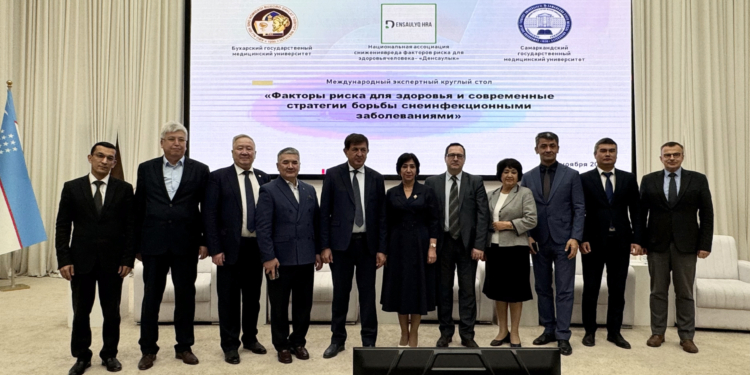
A roundtable discussion featuring experts from Uzbekistan and the CIS countries was held in Bukhara. Participants discussed methods for combating non-communicable diseases, the importance of prevention, and the prospects for harm reduction.
According to the WHO, noncommunicable diseases (NCDs) cause over 70% of all deaths globally. Such diseases are always easier to prevent than to treat. Harm reduction, a concept recognized by the WHO and successfully applied in a number of developed countries, helps achieve this. Its essence lies in replacing more harmful behaviors with less harmful ones, which helps reduce the risk of developing many NCDs.
Opening the roundtable, Shukhrat Teshayev, Rector of Bukhara State Medical University, noted that public health is shaped not only by internal factors such as genetics, but also depends heavily on external factors. He cited air pollution as a key threat for Uzbekistan. Toxic gases from the growing number of vehicles and industry increase the risk of cardiovascular and respiratory diseases. The speaker also highlighted the risks of pesticides in agriculture and the accumulation of low doses of radiation, including frequent medical procedures.
Zafar Aminov, Vice-Rector for International Cooperation at Samarkand State Medical University, emphasized that despite economic growth, inequalities in access to healthcare persist, especially in rural areas, where 51.9% of Uzbekistan's population lives. Urbanization, which has already reached 48.1%, as well as various environmental issues, are changing the disease profile. Chronic NCDs are replacing infectious diseases, accounting for 45% of all medical visits.
Experts also discussed tobacco smoking, which is a major risk factor for NCDs such as cardiovascular disease, cancer, COPD, and other illnesses. Participants concluded that outright bans in this area are ineffective. For example, Saida Umarzoda, an oncologist, professor, and director of the NGO "Right to Health" from Tajikistan, noted that telling someone who has smoked for 40 years "don't smoke" is pointless. Instead, they can be offered a less harmful smokeless alternative to cigarettes, which reduces the toxicological impact on the body. After all, the main harm to smokers is not nicotine, but combustion products—carcinogens, tar, and carbon monoxide—that enter the body along with tobacco smoke. Smokeless alternatives eliminate the combustion process, therefore, the harm is disproportionately less. For example, previously published research data on heated tobacco systems (HTS) show that their aerosol contains 95% fewer harmful components than cigarette smoke.
Grigory Tochilnikov, a Russian expert and representative of the Association of Medical Specialists in Risk Modification, also believes that if a patient is strictly prohibited, they will either leave without receiving proper medical care or seek another specialist. Therefore, it is important to inform them of all the risks and immediately offer scientifically sound, realistic solutions that can help reduce potential harm to health.
Professor Talgat Nurgozhin, Chairman of the Kazakh National Association for Reducing Harm from Risk Factors to Human Health "Densaulyk," also spoke about the ineffectiveness of prohibitive measures, emphasizing that "forbidden fruit is sweet."
Dmitry Ruzanov, a Belarusian expert and Deputy Director for Research at the Republican Scientific and Practical Center for Pulmonology and Phthisiology, emphasized that smokeless products vary from one another. Vaping liquids, for example, require further study. Meanwhile, there is already scientific data on heated tobacco systems (HTS) demonstrating reduced levels of harmful substances in their aerosol compared to traditional tobacco smoke. Specifically, studies show that HTS aerosol has significantly less potential to cause cancer than the tar found in regular cigarette smoke.
The roundtable participants believe that the best solution is to quit smoking completely. This is the so-called "gold standard" to which everyone should strive. However, for those who are not ready to quit, non-combustible alternatives can be offered. Traditional cigarettes are the most harmful form of nicotine consumption, so switching to less harmful alternatives helps reduce the risk of developing NCDs.
An important note is that harm reduction methods do not replace traditional prevention methods, but effectively complement them, helping countries reduce the burden of NCDs on healthcare and helping patients maintain health and quality of life.