Translated with AI


































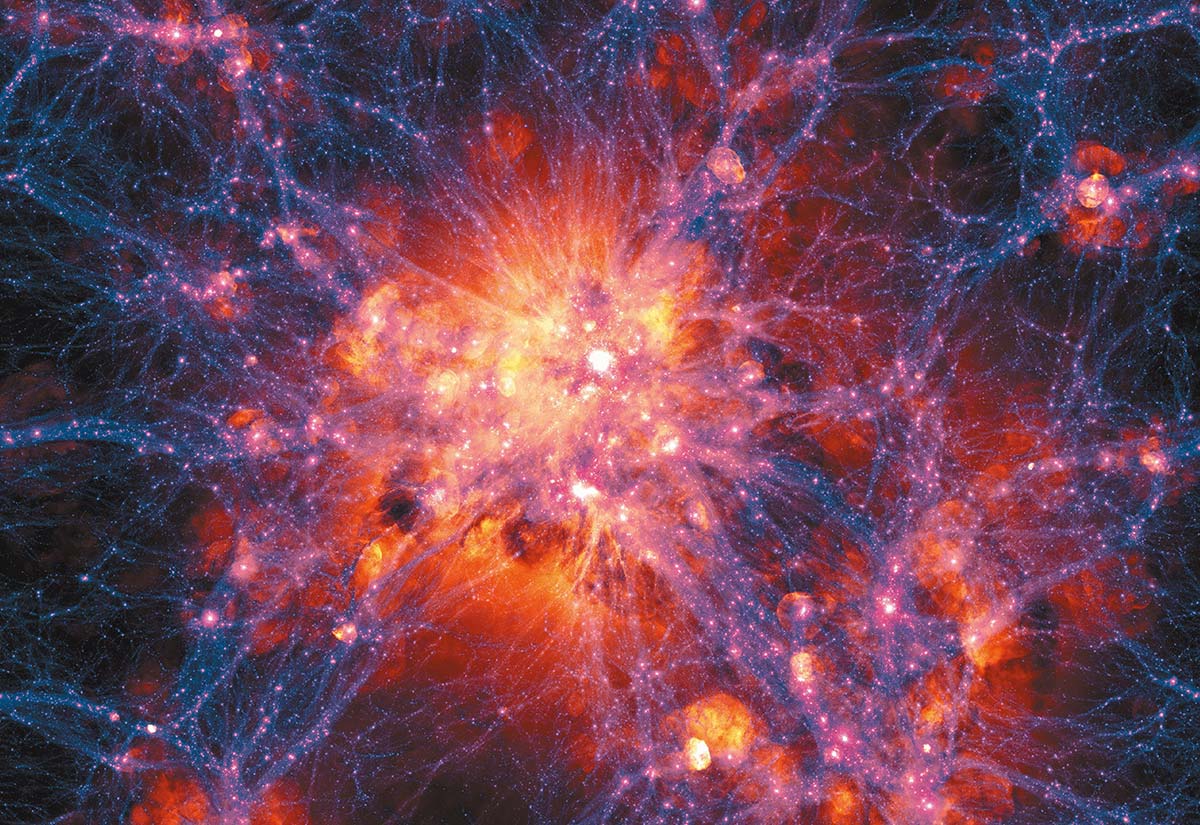
An international team of astronomers has used a spectrograph to detect for the first time a giant hydrogen structure connecting two distant galaxies – quasars. As reported in the journal Nature , the discovery has become an important confirmation of the existence of the so-called “cosmic web” – a system of thin thread-like structures formed by gas and dark matter that connect large galactic formations in the Universe.
The researchers believe the detected hydrogen filament extends for millions of light years and is a remnant of ancient matter that formed shortly after the Big Bang. Such structures have been previously predicted theoretically, but have rarely been directly detected.
In a separate study published earlier this month, astronomers used radio telescopes to detect hundreds of long, filamentary structures near the center of the Milky Way, in the region of the supermassive black hole Sagittarius A*. The objects range in size from a few to hundreds of light-years long and are ejections of ionized gas, visible primarily in radio wavelengths.
As scientists explain, the origin of these threads is connected with high-energy processes occurring around the black hole. There are two main hypotheses: the first is that the structures are formed as a result of the interaction of jets ejected from the black hole with clouds of gas; the second is as a result of the influence of magnetic fields and particles captured by the vortex-like motion that forms in the vicinity of the event horizon.
According to the researchers, studying such threads can shed light on the fundamental processes of galaxy formation, the role of magnetic fields in the Universe, and the activity of supermassive black holes. In the future, with the commissioning of the new international observatory Square Kilometre Array (SKA), astronomers expect to obtain more accurate data on the structure and origin of these unique structures.