Translated with AI































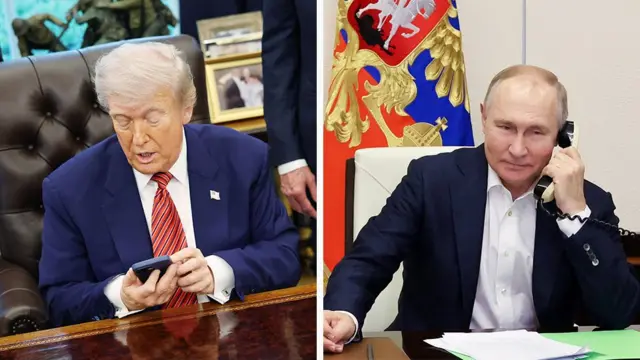
Russian and US Presidents Vladimir Putin and Donald Trump held their second telephone conversation since Trump took office and began implementing his plan to end the war in Ukraine.
The Kremlin reported that the parties continued a detailed and frank exchange of views on the situation in Ukraine and confirmed their intention to continue efforts to resolve the conflict.
According to the Russian side, Vladimir Putin expressed his readiness to jointly explore solutions to the conflict and supported Donald Trump's proposal for a mutual 30-day cessation of attacks on energy infrastructure by Russia and Ukraine. The corresponding order was reportedly given to the Russian military.
At the same time, the Kremlin emphasized that, in the context of the 30-day ceasefire initiative, the Russian side outlined a number of significant conditions. These included the need for effective ceasefire monitoring along the entire line of contact, an end to forced mobilization in Ukraine, and a halt to the rearmament of the Ukrainian army.
Putin also informed Trump that a prisoner exchange of 175 for 175 people is planned for March 19.
The parties agreed to continue efforts to achieve a settlement and to create Russian and American expert groups for further work.
The White House statement reflected the conversation more briefly. It reported that the leaders agreed that progress toward peace must begin with a ceasefire in the energy and infrastructure sectors, as well as technical negotiations on a maritime ceasefire in the Black Sea, a comprehensive ceasefire, and sustainable peace. These negotiations, it noted, should begin in the Middle East.
In addition, the parties discussed the need to limit the proliferation of strategic weapons, the situation in the Middle East as a possible area of cooperation, and the issue of Iran, which, according to the US, should not be given the opportunity to destroy Israel.
Donald Trump later stated that his contacts with Vladimir Putin had been "very good and productive." He stated that an agreement had been reached on an immediate ceasefire at energy facilities, subject to continued efforts to achieve a complete ceasefire.
Commenting on the talks, Ukrainian President Volodymyr Zelenskyy said he expected further details from the American side. He noted his support for the initiative to cease attacks on energy infrastructure, provided Russia takes similar action, but emphasized the need for direct discussions with Donald Trump.
Zelenskyy later stated that Russia continues to strike Ukraine's civilian infrastructure despite its declarations of readiness for peace. He claimed that the refusal to implement a full ceasefire indicates attempts to prolong the conflict.
The two presidents' phone call lasted approximately an hour and a half. Prior to the conversation, Donald Trump stated that he planned to discuss territorial issues and asset allocation, including energy facilities, particularly the Zaporizhzhia Nuclear Power Plant.
Earlier, on February 12, Putin and Trump held their first telephone conversation, during which the parties agreed to continue contacts and arrange a personal meeting.
On February 18, the first high-level talks between Russian and US officials since the war began took place in Saudi Arabia. Ministers and representatives from the two countries' administrations participated.
Subsequently, the US administration's rhetoric toward Russia noticeably softened. In particular, the UN Security Council resolution adopted with US participation made no direct accusations against Russia.
Relations between Washington and Kyiv, on the contrary, have worsened. Donald Trump criticized Volodymyr Zelenskyy, and their meeting in Washington ended in a public conflict. In early March, the US suspended military aid to Ukraine and intelligence sharing.
Later, the Ukrainian side expressed its willingness to cooperate with the United States to achieve peace. Contacts were then resumed, and Ukraine agreed to the 30-day ceasefire proposed by the United States, subject to Russia's consent.
In response, the US resumed military aid and warned of possible sanctions against Russia if the ceasefire was not respected.
A few days later, US Special Representative Steve Witkoff visited Moscow for talks with Vladimir Putin. The Russian side generally supported the initiative, but specified a number of conditions, including monitoring the ceasefire and preventing the pause from being used for rearmament.
Donald Trump described the talks as "promising" but noted that they remain incomplete.
Volodymyr Zelenskyy, in turn, stated that, in his opinion, Russia is not seeking a ceasefire and is taking steps aimed at disrupting the diplomatic process.