Translated with AI
































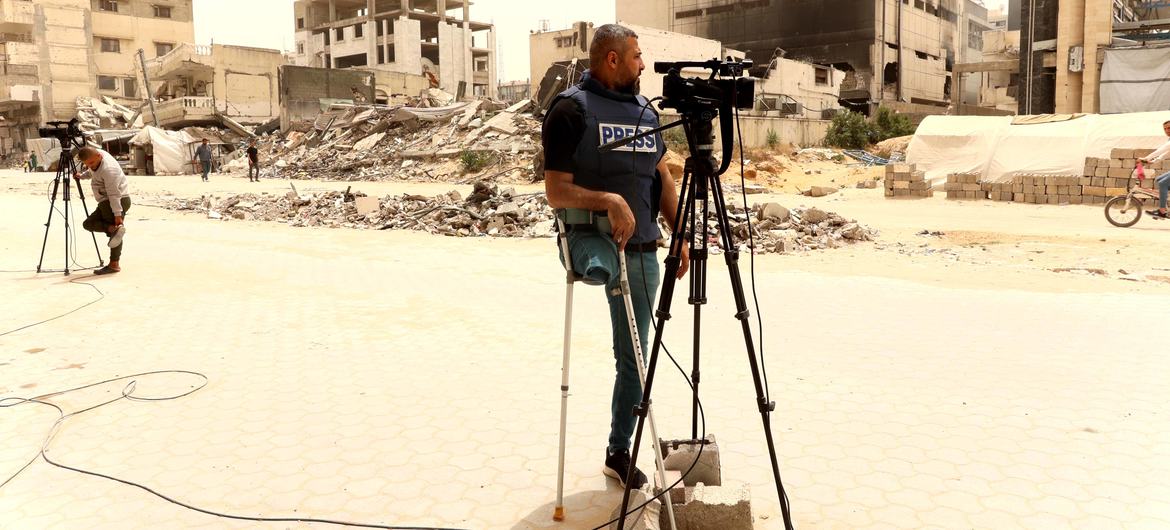
Nearly nine out of ten journalist murders worldwide remain unsolved, UN Secretary-General António Guterres said in his message to mark the International Day to End Impunity for Crimes against Journalists.
According to UNESCO, 163 journalists were killed between August 2023 and May 2025. Of these, 109 media workers, including 12 women, died in conflict zones, primarily in Gaza (46 cases), Sudan (13), and Ukraine (8).
The International Day to End Impunity for Crimes against Journalists was established by the UN General Assembly in 2013 and is observed on November 2. The date was chosen in memory of two French journalists killed in Mali in 2013. This day reminds the international community that impunity for violence against journalists undermines freedom of speech, democracy, and the public's right to reliable information.
“I condemn the killings of journalists in Gaza, express outrage at their high numbers, and call for independent and impartial investigations,” António Guterres said. “The ban preventing international journalists from accessing Gaza is unacceptable.”
Murders of journalists continue to occur even in countries not engulfed in war. According to UNESCO, 15 media workers were killed in Mexico during the same period. The highest number of confirmed journalist murders was recorded in the Arab States (82), followed by countries in Latin America and the Caribbean (34), Africa (5), Asia-Pacific (30), and Europe and North America (12).
The UN Secretary-General emphasized that global impunity for crimes against journalists remains very high. Despite a one-percent decrease compared to 2022, 85 percent of journalist murders remain unsolved.
According to UNESCO, the highest levels of impunity are found in the Middle East and North Africa, followed by the Asia-Pacific region and Africa. The reasons include weak and corrupt law enforcement and judicial systems, lack of political will, and links between politicians, corrupt businesses, and organized crime.
In her message, UNESCO Director-General Audrey Azoulay noted the importance of ensuring the safety of journalists, their independence and protection in the performance of their professional duties.
According to Reporters Without Borders, at least 1,163 journalists were detained between 2023 and 2025, of which 568 remain in custody in 48 countries. Five countries account for nearly half of all journalist imprisonments: Belarus, China, Israel, Myanmar, and the Russian Federation.
In recent years, there has been an increase in the abuse of laws in a number of countries, including defamation laws, counter-terrorism laws and other security-related laws, which are applied in violation of international standards.
There is also a link between high intensity of natural resource exploitation and low press freedom ratings. Between 2013 and 2021, 78 percent of hydrocarbons, 45 percent of mining products, and 67 percent of forest products came from countries with press freedom ratings of "challenging" or "very serious."
Journalists covering environmental issues often face the need to report on violations by large corporations, corruption in government agencies, and the negative impacts of government-approved projects.
"Free and independent journalism is a vital public good, and journalists everywhere must be able to work freely, impartially, and without fear," Guterres emphasized. "Despite this, attacks on journalists continue."
According to the UN Secretary-General, states must end impunity for the killings of journalists through prompt, thorough, impartial and independent investigations.
“When journalists are silenced, we all lose our voice,” concluded António Guterres. “Let us stand together to defend press freedom, demand accountability, and ensure that those who speak truth to power can do so without fear.”