Translated with AI































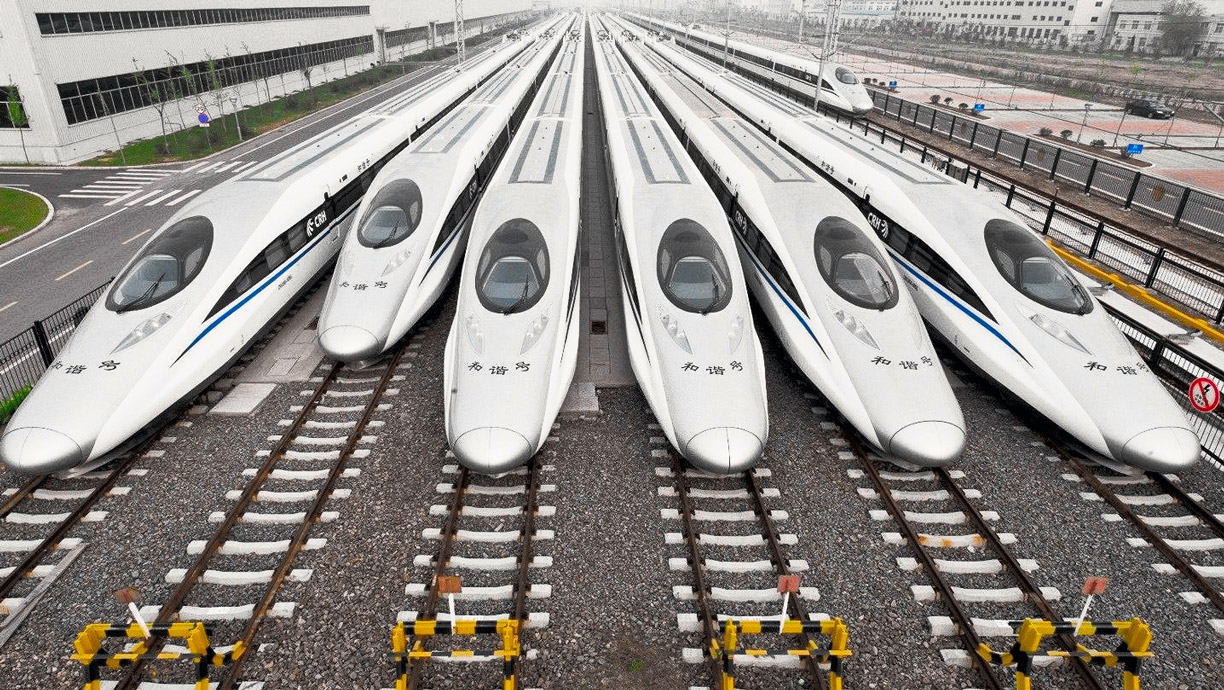
On December 26, 2025, with the opening of a high-speed railway connecting the cities of Xi'an and Yan'an in northwest China's Shaanxi Province, the total length of high-speed railways in operation in China exceeded 50,000 kilometers, according to Xinhua News Agency.
Reaching this milestone marked a new level of high-speed rail development for China and cemented the country's status as a global leader in this field. Specifically, at a recent meeting of the state-owned China Railway Corporation, the goal was announced of increasing the length of high-speed rail lines in operation to approximately 60,000 kilometers by the end of 2030.
China's first high-speed railway opened in 2008, connecting Beijing with Tianjin. Over the past decade, the high-speed railway network has developed from scratch, making a phenomenal leap from a country just catching up to a world leader.
During the 14th Five-Year Plan period (2021–2025) alone, China built and commissioned over 12,000 kilometers of high-speed rail lines. In terms of the length of high-speed rail lines in operation, China ranks first in the world, surpassing all other countries combined. China accounts for 70 percent of the total length of high-speed rail lines in operation worldwide. Furthermore, China leads the world in terms of train speed on these lines.
A well-developed high-speed rail network significantly reduces travel times. Distances of up to 500 kilometers between cities can be covered in just 1–2 hours, between major cities located 1,000 kilometers apart in up to 4 hours, and 2,000 kilometers in 8 hours. Daily passenger traffic on China's high-speed lines can reach 16 million trips, which is comparable to the entire population of a single metropolitan area traveling on the high-speed rail system in a single day.
Yu Jian, an expert at the China Institute of Railway Economics and Planning, noted that China has achieved historic success and high-quality development in high-speed rail transport, which has already become a unique "calling card" of the country and a clear indication of the results of China's modernization drive.
Chinese high-speed rail technology has reached the world's leading level, forming a comprehensive technical system encompassing engineering construction, equipment manufacturing, operations, and management. On December 29, 2024, the prototype of the CR450 electric multi-purpose rolling stock, boasting world-leading performance, was unveiled in Beijing. To date, the CR450 has completed a series of tests on several Chinese lines and reached a speed of 453 kilometers per hour, cementing the country's leadership in high-speed rail.
The construction of high-speed lines is contributing to the comprehensive expansion of domestic demand and the optimization and modernization of China's industrial structure. The high-speed rail equipment industry has become a strategic sector with global competitive advantages.
China's high-speed rail offers environmental benefits, including low-carbon efficiency, and contributes to the construction of a "Beautiful China." It is estimated that passenger transportation during the 14th Five-Year Plan period reduced carbon dioxide emissions by approximately 14.44 million tons compared to similar road transport volumes.
China is also actively promoting its high-speed rail technologies internationally. In the past five years, the Jakarta–Bandung line in Indonesia, built jointly with China, has been commissioned, reducing travel time between the cities from over three hours to 46 minutes. The Serbian section of the Hungary–Serbia railway has also been commissioned, integrating Chinese railway technologies with EU technical standards. The full suite of China's ticketing system technologies has been successfully applied on the Jakarta–Bandung High-Speed Railway, the China–Laos Railway, the Hungary–Serbia Railway, and lines in Sri Lanka.
An article in the Chinese daily newspaper Jingji Ribao notes that high-speed railways have become not only a modern transportation system but also an important element in monitoring the evolution of the country's economic geography, industrial modernization, and innovative development. The author emphasized that the high-speed railways are a concentrated embodiment of industrial might and engineering wisdom: the train consists of over 40,000 components, and its production requires the coordination of more than ten industries, including steel, metallurgy, materials, electronics, and information technology.
High-speed railways not only reduce spatial and temporal distances but also improve the efficiency of production factor movement. In the Beijing–Tianjin–Hebei region, the Yangtze Delta, and the Guangdong–Hong Kong–Macao Greater Bay Area, high-speed railways have enabled urban agglomerations to achieve a "one-city" effect, creating scientific and technological innovation corridors and industrial development belts.
A dense network of high-speed lines helps unlock the potential of China's massive domestic market and stimulates the rapid development of tourism, food service, logistics, and other service sectors in the country, the author of the article emphasizes.