Translated with AI



















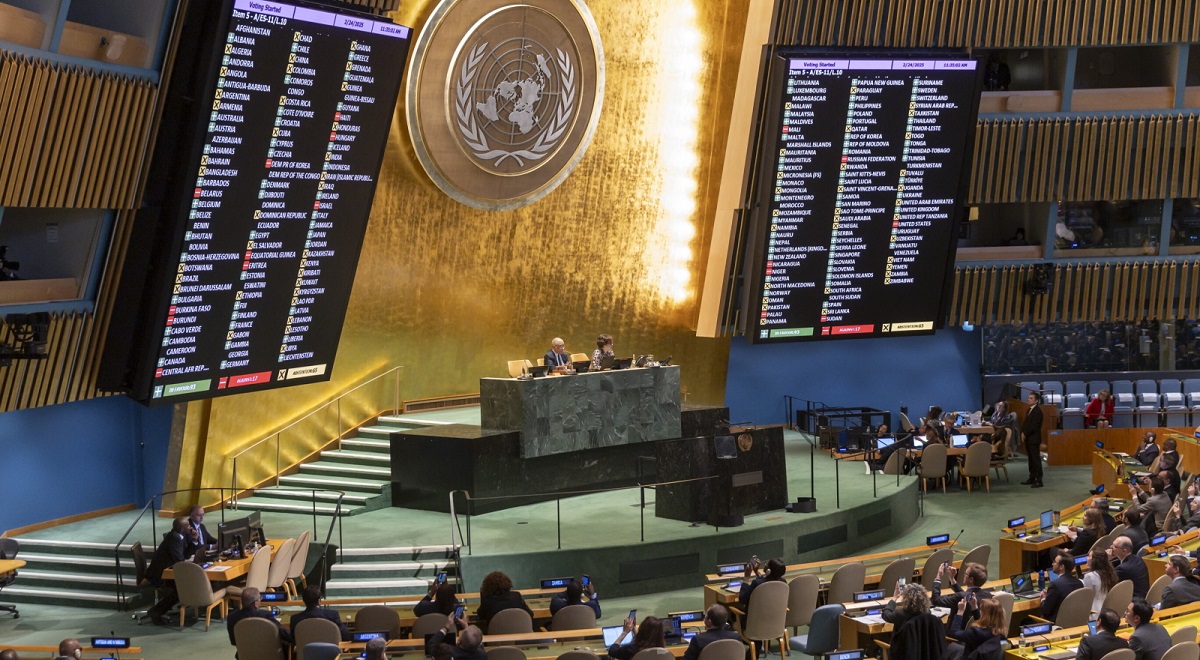
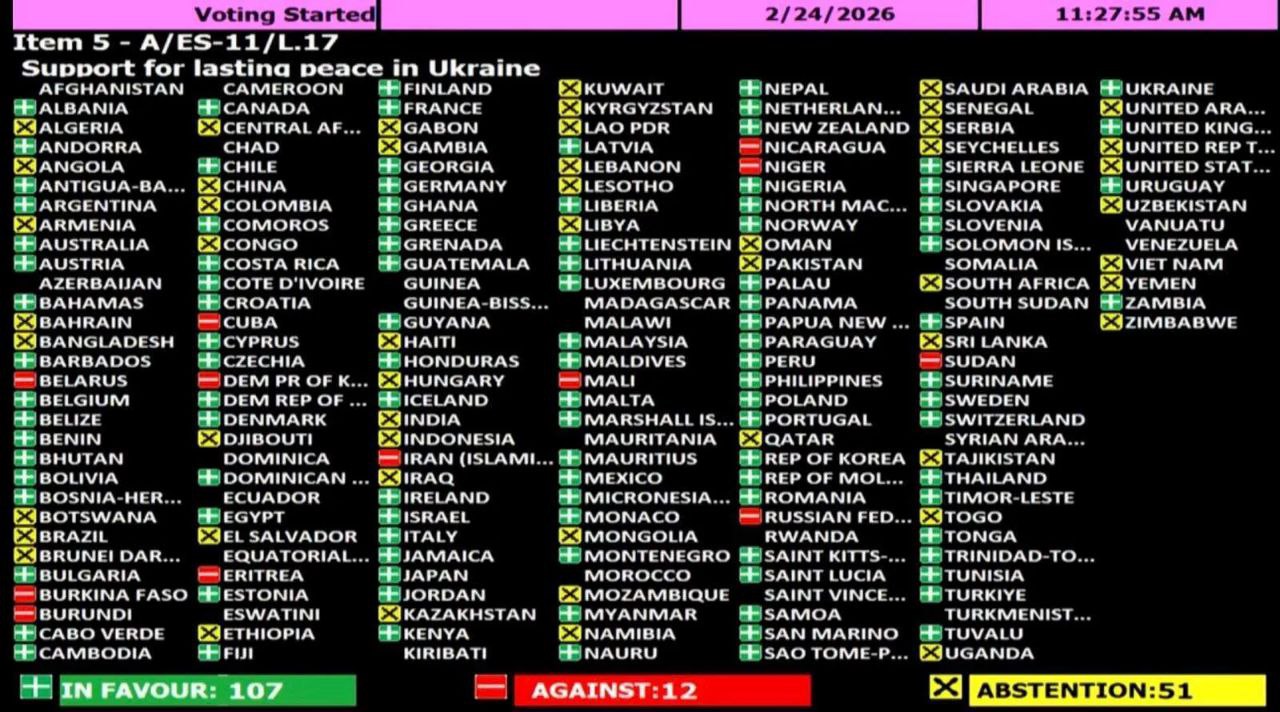
On the fourth anniversary of Russia's full-scale invasion of Ukraine, the UN General Assembly adopted a resolution entitled "Support for a Lasting Peace in Ukraine." Representatives of 107 states voted in favor of the document, which affirms Ukraine's right to sovereignty, independence, unity, and territorial integrity within its internationally recognized borders, at its meeting in New York on Tuesday, February 24.
Representatives of 12 countries voted against the resolution: the Russian Federation, Belarus, Burkina Faso, Burundi, Cuba, North Korea, Eritrea, Iran, Mali, Niger, Nicaragua, and Sudan. Another 51 countries abstained, including the United States, China, India, South Africa, Armenia, Kazakhstan, Tajikistan, Kyrgyzstan, Brazil, and the United Arab Emirates. The document calls for an immediate ceasefire in Ukraine, a full exchange of prisoners of war, the release of all persons illegally detained by Russia, and the return of civilians to Ukraine.
Ukrainian Foreign Minister Andriy Sybiha welcomed the adoption of the resolution by the UN General Assembly. "At crucial moments, the international community must clearly state its position. That's true today," he wrote on the social media site X. He added that for Ukraine, this is "not just another vote," but confirmation that the country is not alone and that the principles of the UN Charter still matter.
"We will continue to act – firmly and consistently – to achieve a comprehensive, just and lasting peace in accordance with the UN Charter and international law," Sibiga emphasized.
The United States demanded a separate vote on the resolution's provisions. Specifically, Washington insisted on a vote on the provision on Ukraine's territorial integrity and on the paragraph calling for a "comprehensive, just, and lasting" peace in accordance with international law.
US Deputy Representative to the UN Tammy Bruce stated that the US supports the call for an immediate ceasefire. However, she noted that the resolution overall contains provisions "that could derail ongoing negotiations rather than support all diplomatic channels to pave the way for lasting peace." The US demand for a separate vote failed to gain support, so Washington abstained.
That same day, Russian Deputy Foreign Minister Dmitry Lyubinsky addressed the UN Human Rights Council in Geneva to a half-empty audience. His speech was boycotted by representatives of approximately 40 Western countries. In response, Lyubinsky accused Europe of "Russophobia."