Translated with AI

































Liu Ting (CGTN)
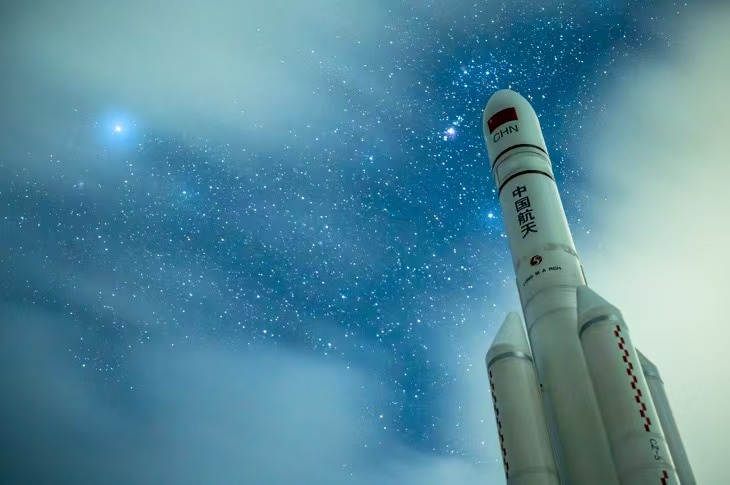
April 24 marks National Space Day in China. The year 2026 marks the glorious 70th anniversary of Chinese space exploration. This journey, which began in 1956 and included the launch of China's first domestic satellite, Dongfanghong-1, in 1970, has led to the creation of the modern Tiangong orbital station, the Chang'e lunar rovers, the Zhurong Mars rover, and the Xi He solar probe. Over the course of seven decades, Chinese space exploration has evolved from a complete lack of indigenous developments to a leading position in global science.
Self-reliance
China's space program has achieved a number of historic successes. The Chang'e-4 mission achieved the first soft landing on the far side of the Moon, while Chang'e-5 returned 1,731 grams of lunar soil from the lunar surface to Earth. The BeiDou-3 global navigation system has been fully deployed and operational. Tianwen-1 completed a Mars flyby, landing, and rover deployment in a single flight. China's Tiangong space station has been completed and is now in operation. Chang'e-6 collected 1,935.3 grams of lunar soil from the far side—another first in human history. These achievements occurred in the last decade—the most dynamic and productive period in China's space exploration.
Modern Long March series launch vehicles are now capable of launching spacecraft of varying weights and missions into various orbits. China has become the world leader in launch accuracy. During this time, the country has achieved significant technological breakthroughs:
- introduced cryogenic fuel;
- increased the number of simultaneously launched satellites: from one to several;
- expanded the geography of launches: now launches are carried out from both land and sea platforms;
- increased the complexity and range of missions: from satellite launches to manned flights and space exploration.
China has developed and launched over a thousand artificial satellites into orbit, including experimental, scientific, and applied ones. Their role in technological development, fundamental science, daily life, and the country's defense capability is difficult to overestimate.
Manned spaceflight is one of the most complex aerospace projects of our time. It reflects the level of scientific, technological, and economic development of a country. Key milestones in this field include:
- In October 2003, the Shenzhou-5 spacecraft sent China's first taikonaut into space;
- In June 2022, with the launch of Shenzhou-14, three crew members entered the Tianhe core module, marking a crucial phase of the station's construction.
Today, the Tiangong orbital station is functioning stably, ensuring the long-term presence of humans in orbit.
During the 15th Five-Year Plan, China will launch new projects: Hongmeng, Kuafu-2, exoplanet exploration, and eXTP. Their goal is to shed light on the origins of the universe: study the early stages of its development, solar activity cycles, find Earth-like planets around other stars, and explore the laws of physics in extreme conditions.
Openness, collaboration and sharing for the world
Since 2011, China's international cooperation in space has been rapidly expanding. Adhering to the principle of open partnership, the country is increasingly making space resources available to scientists worldwide. China has signed space agreements with more than 50 countries. This cooperation covers a wide range of areas: from launch and payload deployment services to joint satellite development, the creation of collaboration mechanisms, data exchange, and joint deep space exploration and human spaceflight missions.
Vivid examples of such interaction:
- The Chinese space station became the first orbital station in history open to all UN member states. Nine projects from 17 countries were selected for the first pool of scientific experiments;
- The Chang'e-6 mission carried four international payloads from France, ESA, Pakistan and Italy;
- Chang'e-7 will carry six instruments from seven countries and international organizations, including Russia, Egypt, Italy and others, to the Moon;
- China's initiative to create an International Lunar Research Station has received support from Russia, Kazakhstan, South Africa, Thailand, the ESA and others;
- Lunar soil samples returned by Chang'e-5 are being jointly studied by six countries, including France and the UK.
In March 2026, China published the "Action Plan for International Cooperation in Open Science." The document opens the world to ten major scientific infrastructures. Among them is the Ziwu ground-based space environment monitoring network, one of the largest and most powerful in the world. With the exception of data related to national security, all information is open for international exchange and is already used by 18 countries.
The available infrastructure also includes a ground-based space environment simulation complex, a pulsed ultra-high magnetic field facility, a high-altitude cosmic ray observatory, and a spherical radio telescope with a 500-meter aperture. These resources will provide an important scientific foundation for the joint study of deep space.
Beyond the Earth – together
China's space science development roadmap to 2050 includes three stages:
- By 2027:
- operation of the orbital station;
- manned flight to the moon;
- implementation of the fourth stage of the lunar program;
- planetary exploration program.
- By 2035:
- creation of the International Lunar Research Station;
- exploration of the outskirts of the solar system;
- study of giant planet systems;
- Venus Atmosphere Sample Return Mission.
- By 2050, China aims to take a leading position in key areas of space science.
At the same time, the country adheres to the principle of peaceful use of space and the philosophy of joint consultation, construction, and utilization of results. China remains open to partnership and is ready to share experience, technology, and resources for the common future of humanity both on Earth and in space.