Translated with AI
































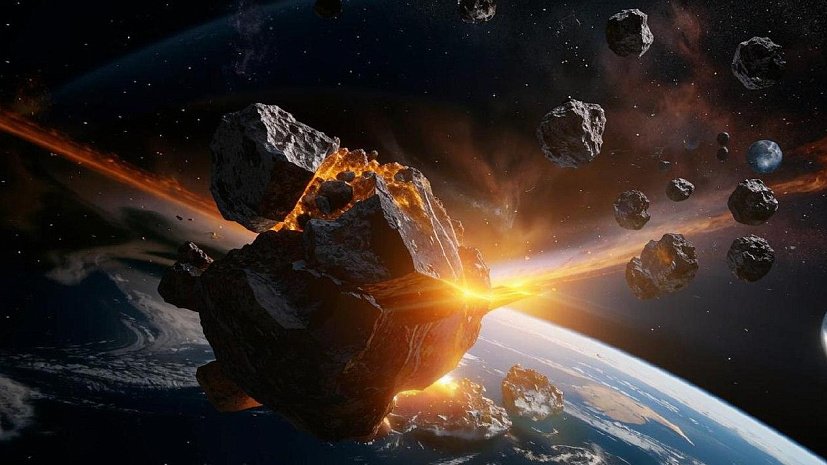
Scientists continue to closely monitor the near-Earth asteroid 2024 YR4 , discovered in December 2024; initial estimates of the probability of a collision with Earth (up to 3.1% in early 2025) have been revised after additional observations, and according to NASA, the object is unlikely to pose a significant threat of a direct impact on our planet in 2032.
Special calculations indicate that a more realistic scenario remains a few percent probability of 2024 YR4 colliding with the Moon . Estimates based on observations, including those from the James Webb Space Telescope, suggest a probability of approximately 4% for the next close approach on December 22, 2032. Under this scenario, an impact on the lunar surface could eject a significant mass of regolith and debris into space, some of which could potentially reach near-Earth space within a few days. This, as the study authors note, would significantly increase the risk of damage to satellites and orbital stations.
In a number of recent studies, international teams of scientists and engineers have examined reconnaissance and possible defense options. Specifically, a study published on the arXiv preprint server analyzes options for sending a reconnaissance probe as early as 2028 and a launch date for a defense mission—tentatively between 2029 and 2031 (with an arrival before 2032). The authors point out that additional data on the mass, density, and internal structure of the celestial body are needed to correctly select a countermeasure.
It is noted that methods similar to kinetic impact (like DART in 2022) could prove ineffective or even dangerous in the case of 2024 YR4: a weak impact might not shift the object's trajectory, while a strong one could break the object into large fragments, worsening the situation. Therefore, a "nuclear destruction" mission is being discussed as an extreme, but potentially effective, option—detonating a nuclear charge near or directly on the object to fragment it into small pieces that would burn up in the atmosphere or pose no threat. Researchers emphasize, however, that the use of nuclear weapons in space is associated with a vast array of technical, legal, and political issues and risks.
One impact assessment study suggests that a 60-meter-wide impact on the Moon could release an energy equivalent to several megatons of TNT (published calculations suggest a value of ~6.5 Mt), and the amount of material torn from the lunar surface could reach tens of millions of kilograms. In the worst case, this would lead to a multiple (estimated at ~10³ times) increase in the flux of small particles in near-Earth space for a limited period, increasing the risk to satellites. However, most models also indicate that the likelihood of the complete "destruction" of all satellites and orbital stations in such a scenario is exaggerated; the actual consequences depend on the magnitude of the released mass, the size of the fragments, their velocities, and their orbits.
Experts urge not to panic, but to act proactively: they propose accelerating observational data collection, refining the physical characteristics of 2024 YR4, and developing designs for potential reconnaissance and defense vehicles. According to the study authors, failing to prepare and design missions now could lead to lost time at a critical moment, while timely reconnaissance will increase the chances of choosing the safest and most effective strategy.