Translated with AI










They hail from different corners of the world, but they share a common courage that allows them to overcome challenges and shine in everyday life. These women are changing the concept of strength with their inspiring stories across continents and cultures.
Their stories transcend borders and languages, weaving together a collective narrative of resilience, creativity, and hope that resonates with the spirit of the Global Leadership Summit on Women. Their life journeys are not just isolated testaments to an era, but also beats of the common pulse of all humanity.
DOING SMALL THINGS WITH GREAT LOVE
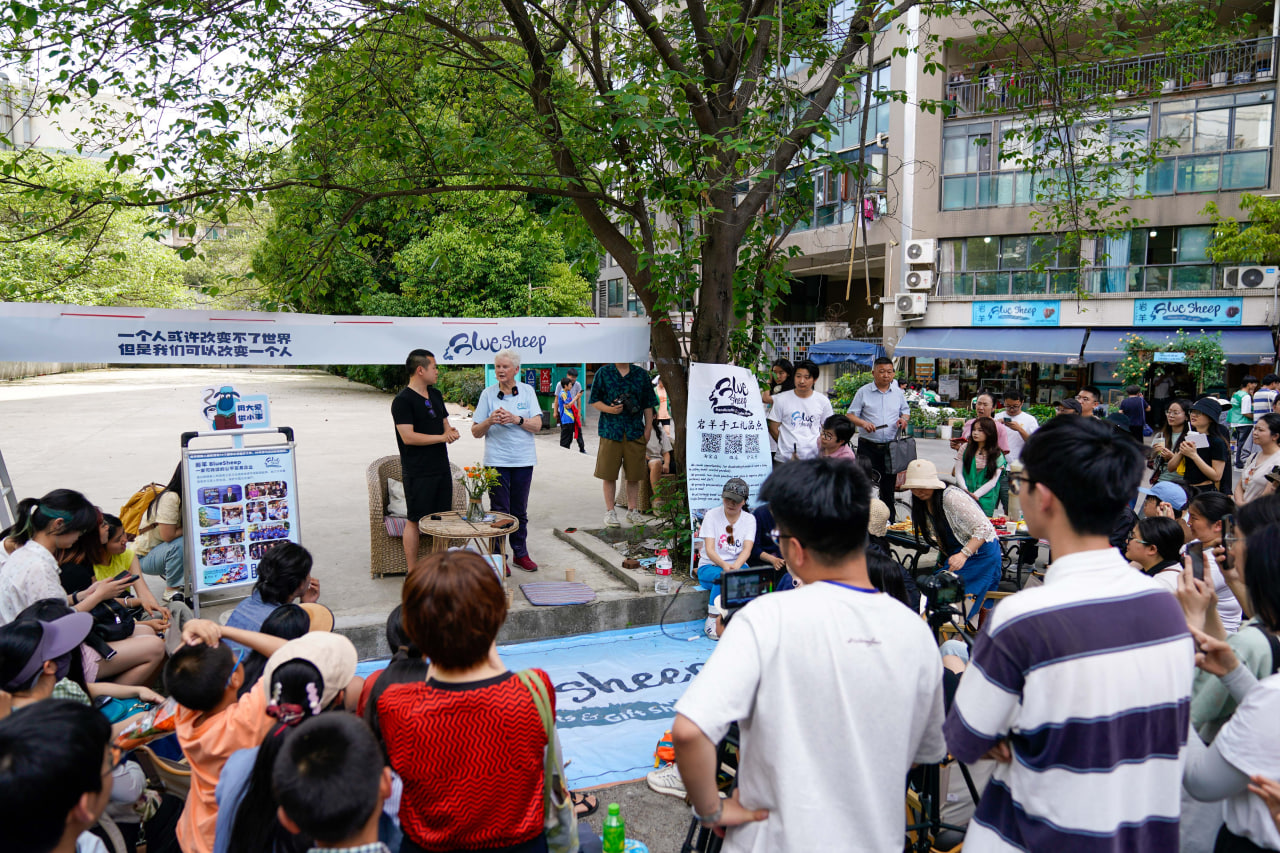
A farewell party was held in front of a small handicraft shop called "Blue Sheep" in Chengdu, the capital of Sichuan Province in southwest China. The guest of honor was Rachel Grace Pinninger, an elderly British woman who has dedicated the last five decades of her life to working abroad.
Rachel Grace was born in 1945 in Shaftesbury, England, the youngest daughter of a doctor. After graduating from the University of Bristol in 1968, she gave up a well-paid, stable job to begin her odyssey through conflict zones and disasters in Asia and Africa, choosing healthcare and medical education in 15 developing countries as her field.
In 2008, she came to Sichuan Province to help victims of the Wenchuan earthquake and conduct training programs for people disabled by the disaster.
April 19, Chengdu, China. Rachel Grace Pinninger (center, under the sign "Blue Sheep") tells the story of her life in the city. /Photo: Xinhua/
In 2013, Rachel Grace opened a modest shop in Chengdu called "Blue Sheep," specializing in handicrafts made by people with disabilities and from low-income families. When she first proposed opening the shop, many people discouraged her. "Everyone said, 'Don't do it, it won't work,'" she recalls. But she stood her ground: "I figured if it failed in a year or two, it wouldn't be such a big deal."
More than a decade later, her shop has not only survived but is thriving. It now features approximately 20,000 handicrafts from 13 ethnic groups. Over the past decade, the shop has supported more than 1,000 vulnerable residents of the province.
Rachel Grace Pinninger (second from right) listens to a disabled craftsman talk about his life on April 19 in Chengdu, China. /Photo: Xinhua/
"People think charity is giving away something for free," says Rachel Grace, "but what they really want is to be treated with dignity, to be seen as capable, not to be pitied." Watching people gain self-worth through acceptance and seeing them blossom when they are valued for who they are is truly life-changing, she says.
EMPOWERED BECAUSE I'M A WOMAN
In a bustling coffee processing factory in Kinshasa, the capital of the Democratic Republic of Congo, 33-year-old Tissya Mukuna moved gracefully past rows of roaring roasters, her flowing, multicolored dress a striking contrast to the surrounding industrial environment. The founder of La Kinoise (or "The Woman from Kinshasa") is enthusiastically known by locals as the "queen of coffee."
Tisya has traveled the world. She studied marketing in France and earned an MBA in Shanghai, China. Her parents once envisioned her working for a multinational company in New York, but instead she returned to her homeland, determined to start her own business.
September 29, Kinshasa, DRC. La Kinoise coffee company founder Tissya Mukuna (aka "Woman of Kinshasa") talks to an employee at the factory. /Photo: Xinhua/
In 2018, she turned her attention to the coffee industry. "As a Congolese woman, I wanted to contribute to the development of my country."
However, entrepreneurship proved far from easy. Tisya faced numerous challenges, including a lack of funding, unstable power supply, unreliable equipment, and poor infrastructure. Compounding the challenge was the fact that she was a female entrepreneur.
Tisya admits that she initially doubted herself as a "newcomer" in the industry. In the male-dominated coffee business, she was often treated with arrogance.
"They didn't shake me. On the contrary, they made me stronger," emphasizes the "coffee queen" of Kinshasa.
In 2023, its Robusta coffee won an award at the Paris International Agricultural Exhibition, bringing pride and attention back to Congolese coffee beans.
LIFE IS STRONGER THAN DEATH
At dawn, Somaya Shomer walked through the narrow alleys of the Nuseirat refugee camp, her flowing white robe like armor. In Gaza, it is both her uniform and her shield—a silent protest amidst the destruction.
At the Al-Awda field hospital, a 34-year-old obstetrician and gynecologist, a mother herself, delivered a baby amid the ruins. The cries of the newborns mingled with the echoes of distant artillery fire.
"During my previous pregnancies, I enjoyed every stage," Somaya told Xinhua. "But this time, I feel a burden of anxiety—about my health, food shortages, and the ongoing conflict." Food and medicine are scarce, and even rest has become a luxury. "Sometimes I fall asleep in my work clothes," she adds.
A Palestinian child suffering from malnutrition and cerebral palsy is seen in a temporary shelter at a school in Gaza City, July 25. /Photo: Xinhua/
Until the final stages of her current pregnancy, Somaya worked over 50 hours a week. Now she sees over 200 patients daily, many of whom are displaced and in desperate situations.
Every cry she hears from a newborn is a kind of desperation, so she tries with all her might to save him.
"With every birth, we feel that hope is still possible, that life is stronger than death," Somaya said. "Every child born in Gaza is a message that our people are clinging to life, despite all the difficulties."