Translated with AI




















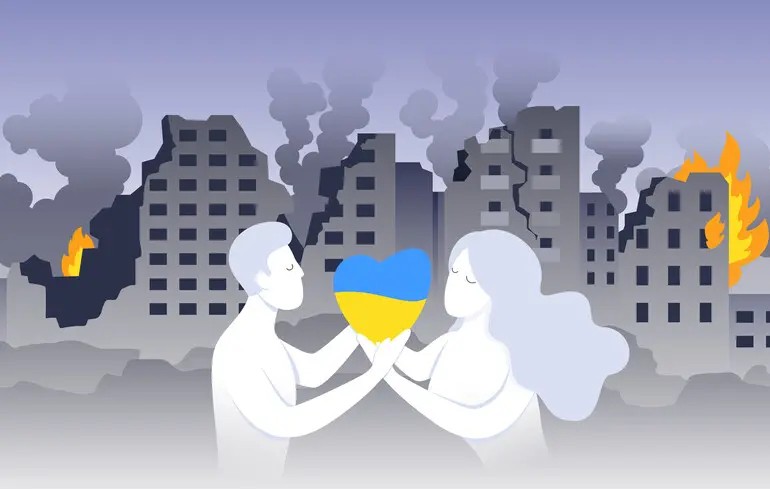
February 24, 2022, became more than just a date for Ukraine; it was a turning point, a life-changing event. For millions of people, war became a terrifying routine. From morning to night, from one air raid alarm to the next, from a call to family to a short message saying, "I'm alive."
In February 2026, this war is no longer perceived as a "blip" that can be weathered. It has become a test of endurance, of humanity, of society's ability to hold on when the familiar world collapses. And it remains a war of the 21st century, where the front runs not only along trenches but also through the lives of people, schools, hospitals, power plants, and city blocks.
Ukraine today lives in a reality where every morning begins with explosions and where even silence sometimes sounds like anticipation of an attack. But it is precisely in this reality that something difficult to quantify has become evident: human resilience.
The war has taken too much from us, especially over the last four years. It's not just the destroyed buildings and burned-out neighborhoods, but, most importantly, the lives and fates of people.
Millions of Ukrainians have become internally displaced persons or refugees, making this one of the greatest humanitarian tragedies of modern times in Europe.
According to the International Organization for Migration, as of January 2026, there were approximately 3.7 million internally displaced persons in Ukraine.
UN agencies are simultaneously recording millions of Ukrainians who remain outside the country as refugees, while in the European Union alone, 4.35 million people were registered under the temporary protection mechanism as of December 31, 2025.
The scale of the economic damage is also enormous. A joint assessment by the Ukrainian government, the World Bank, the European Commission, and the UN estimated Ukraine's recovery needs at $524 billion over a ten-year horizon (as of December 31, 2024). This figure includes destroyed schools, damaged hospitals, destroyed homes, torn-up roads, and a devastated energy system.
But war isn't measured only by numbers; it's measured by how human lives change. Families live in constant tension. Children mature faster because they're forced to understand things they shouldn't. Their parents learn to distinguish previously unfamiliar sounds: where a missile is, where a drone is, where "far away" is, and where "very close," where air defense activity is, and where "incoming" is.
And yet, it is precisely in everyday Ukrainian life today that there is something that amazes the world: even under missile attacks, people remain human.
War is often discussed in the language of statistics, jurisprudence, and diplomacy. But there is another language, the language of life. And one of its most powerful arguments is this: children continue to be born in Ukraine during the war.
Over the past four years, more than 750,000 births have been registered in Ukraine. These figures are important not only for demographers; they speak to human choice. They speak to the fact that even when the world seems to be falling apart, families still create a future.
Every child born during these years is the story of parents who made their choice. It's the story of a maternity hospital that delivers women during shelling. It's the story of doctors who never left their country. It's the story of cities without power due to attacks on the power grid, but where there's the warmth of human hands.
Yes, the birth rate is declining, and that's part of the overall demographic burden of the war. But the very fact that hundreds of thousands of little Ukrainians have been born in four years is proof that Ukraine has not been broken, has not been "cancelled," has not been forced to disappear.
And, of course, this became possible in large part thanks to the Ukrainian Defense Forces.
For Ukrainians, the Armed Forces are no longer an abstraction or a state institution. These are the people who literally shielded the country when the enemy seemed stronger in every way.
Russia is a nuclear power with one of the largest armies in the world.
And yet, Ukraine persevered. Moreover, a conviction emerged in the national consciousness that is important to acknowledge: we "won" when, in the first weeks and months of the war, we prevented the enemy from capturing the capital and thwarted the Kremlin's blitzkrieg scenario. By early April 2022, Ukraine had regained control over the entire Kyiv region.
This, of course, wasn't the "end of the war," but it was a turning point. Our people realized they had preserved the country as a living reality, with a powerful army, an effective system of governance, a functioning economy, serious diplomacy, and other vital state and social institutions. With the ability to resist, rather than disappear in a matter of days.
And here's where one detail arises that our friends in Tajikistan should understand. For Ukrainians, participating in the defense of their country almost always has a simple motivation: to protect their home, their family, their street, their city. It's a lifelong motivation.
Against this backdrop, it's particularly noticeable that Russia has systematically increased recruitment for the war through financial incentives and administrative pressure. This doesn't negate the personal motives of individuals, but it does highlight the state model: war must be "bought."
At the same time, Russia exploited its prison resources. In 2023, Reuters reported on the pardoning of thousands of former prisoners who had fought with the Wagner PMC, as well as the mass recruitment of prisoners with the promise of freedom.
In January 2026, Reuters quoted statements that more than 422,000 people had signed contracts with the Russian army in 2025 alone.
These facts are needed to honestly demonstrate the difference in motivations. Ukraine defends itself because it's its life. Russia replenishes its troops through a system of payments, contracts, benefits, vulnerability, and coercion.
Another detail is important for the Tajik audience. International observers and investigative journalists have repeatedly raised the issue of migrants and foreigners being drawn into the war on the side of the aggressor. This includes reports of pressure on migrant workers, recruitment through promises of citizenship, or threats of deportation.
This war affects the region more broadly than it seems. And so, talking about it in Tajikistan isn't "foreign." It concerns human lives and the right of people not to become expendable material for someone else's decisions.
War exists not only on the ground and in the sky; it exists in people's minds. And here, the difference between Ukrainians' and Russians' perceptions of war has become one of the deepest chasms of our time.
For Ukrainians, war is a personal tragedy. It means the funerals of loved ones, a destroyed home, evacuation. It's something impossible to forget, much less forgive.
For millions of Russians, the war is often presented as some kind of "special operation," where it is supposedly not an attack but a "mission," and the state deliberately creates precisely this framework.
Since the invasion began, Russia has adopted repressive laws criminalizing independent reporting on the war and any information that deviates from the official line. Human Rights Watch has documented that laws on "fake news" and "discrediting" the army have effectively criminalized the truth about the war and intensified persecution of anti-war protests.
Other human rights organizations noted that these regulations provide for strict time limits, and effectively leave society in the realm of state information as the “only permissible” one.
This is the mechanism through which lies begin to function as state policy. Not just as propaganda rhetoric, but as a system where telling the truth can be punished, while lying can bring rewards, approval, and impunity.
Why is it important to talk about this? Because in such conditions, war becomes the "norm" for those who don't hear the sirens. It can become an image, a story, an abstract "geopolitics."
And when war becomes an abstraction, it’s easier to find excuses, easier to say that “everything is complicated,” easier to shift responsibility to “circumstances,” and easier to continue.
But reality is stubborn. It brings the conversation back to simple questions: who crossed the border, who is shooting, who is destroying, who is forcing people to flee, who is the aggressor. And here, international law exists at least as a moral anchor: borders should not be changed by force, and peace cannot be built on rewarding aggression.
That's why Ukraine speaks of a just peace. Not peace "at any cost," but a peace that eliminates the perception that violence is profitable.
Every country has its own memory, its own problems, and its own life. But there are common human values that are understandable to everyone who has experienced pain and loss.
The world is built on rules. These rules aren't needed by the strong. They're needed by those who are weaker in times of danger. They're needed by ordinary people who want to raise children, work, and build houses, not live in shelters.
And here it's especially appropriate to remind people of solidarity. Over the past four years, Ukrainians have received assistance in various forms: some have taken in refugees, others have provided treatment, education, rehabilitation, or simply kind words.
We are grateful to everyone who helped Ukrainians, regardless of distance or language. We are grateful to the governments and peoples of other countries who provided military and financial assistance to Ukraine. At moments like these, you realize: human compassion transcends borders.
Today, Ukraine is not only defending itself, it is defending principles: borders cannot be changed by force. We must not become accustomed to violence—it will lead to repetition. It is important to adhere to simple principles: human life, dignity, truth, and the right of people to live in their own homes.
Ukraine stands and will stand. Because for us, war is not "politics," but a matter of life and death.
And February 24th will never again be an ordinary day for Ukrainians. Too many lives were divided into "before" and "after." We lost too many for this to be forgotten.
Glory to Ukraine!