Translated with AI






























The US military launched a new series of strikes against Iran on Wednesday evening, shortly after US President Donald Trump declared the ceasefire agreement expired. The new exchange of strikes occurred against the backdrop of a NATO summit in Ankara and the escalating situation around the Strait of Hormuz following Iranian attacks on merchant ships.
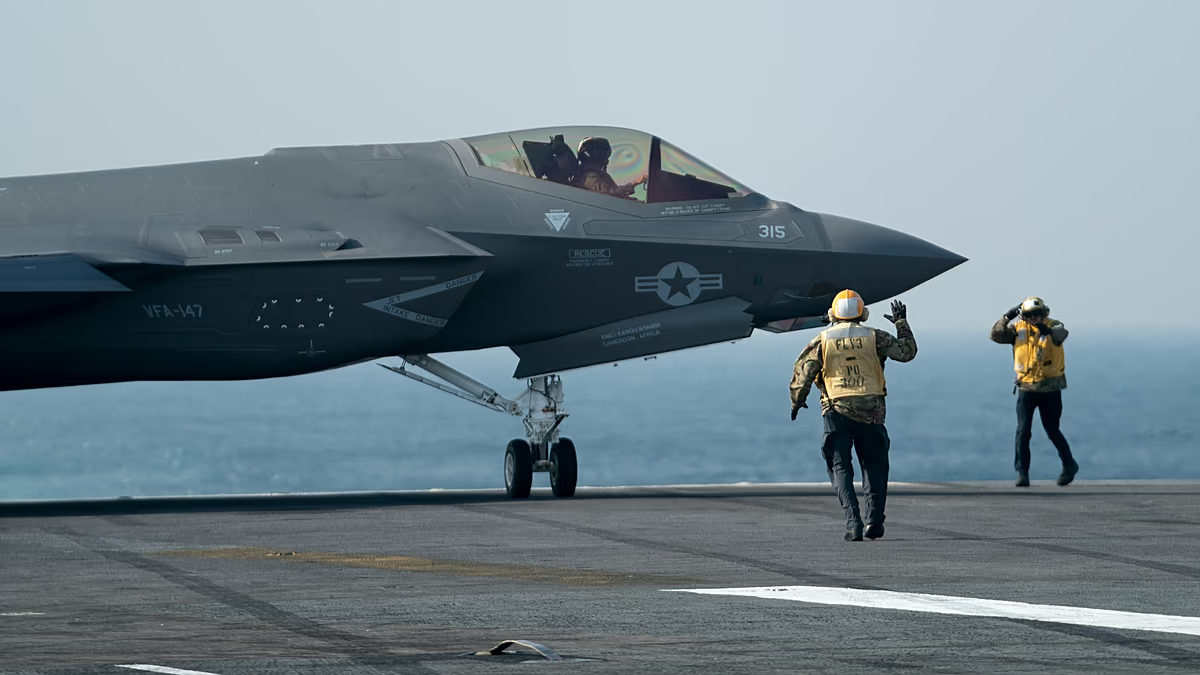
US Central Command announced that, at the direction of the Commander-in-Chief, American forces have launched additional strikes on Iranian territory. The command stated that the goal of the operation was to further weaken Tehran's ability to threaten freedom of navigation in the Strait of Hormuz.
The US military statement also said the United States intends to hold Iran accountable for recent attacks on commercial vessels and civilian crews transiting a key international shipping route.
Commenting on the strikes, US President Donald Trump called them a response to Iranian attacks on ships.
"This is revenge for Iran's bombing of ships yesterday. If it happens again, it will be much worse!" Trump wrote on Truth Social.
The US military later announced that the new wave of strikes had ended. According to them, 90 targets were attacked. These included air defense systems, missile and drone depots, naval facilities, and logistics infrastructure located along the Iranian coast.
Iran's state news agency IRNA reported explosions in several cities on the country's southern coast near the Strait of Hormuz. Specifically, explosions occurred in Bandar Abbas, home to Iran's largest port and key naval and Islamic Revolutionary Guard Corps facilities.
The strikes also affected Chabahar, Konarak, and Sirik, as well as Lavan Island. Power was disrupted in some areas of Chabahar.
According to state television channel IRIB, two piers and a maritime control tower were attacked in Chabahar.
Iran's state-run Press TV reported explosions in the terminal building and on the runway at Iranshahr Airport in the southeast of the country.
According to IRNA, a firefighter was killed at the airport. The air traffic control building and the meteorological station were damaged.
The Tasnim news agency reported that a missile damaged a railway bridge in northern Iran. According to the semi-official Fars news agency, explosions were also heard in Bushehr.
This port city is home to a nuclear power plant, which Russia is co-constructing. Nournews, an agency affiliated with Iran's Supreme National Security Council, reported that the plant was not damaged.
Citing a military source, Nournews also reported that Iran intends to resume "massive attacks" on American military bases in the region in the near future.
Air raid sirens sounded in Bahrain and Kuwait. The Kuwaiti Ministry of Defense reported repelling missile and drone attacks.
The Islamic Revolutionary Guard Corps said it struck two US bases in Kuwait and two other US military facilities in Bahrain.
On the eve, the US and Iran resumed exchanging strikes for the first time since technical talks in Qatar last week.
The US military then reported dozens of attacks on military targets in Iran. Washington stated that the operation was a response to Iranian attacks on tankers near the Strait of Hormuz on Monday and Tuesday.
Iran, in turn, announced strikes on American military bases in Kuwait and Bahrain.
Trump announced the end of the ceasefire
The resumption of hostilities occurred during Donald Trump's participation in the NATO summit in Turkey.
Journalists asked the American president whether the memorandum of understanding signed between the United States and Iran in June had expired.
The document provided for a 60-day negotiation process, the unblocking of the Strait of Hormuz by both sides, and the easing of American restrictions on Tehran.
"It's a very interesting question. I think it's over. I don't want to deal with them. They're sick people. They're led by sick people," Trump said.
According to the US President, further contacts with the Iranian leadership are a "waste of time." Trump then announced a new wave of American strikes against Iran.
A US official, speaking on condition of anonymity, told Reuters that the strikes on Iran on Wednesday would be more numerous than those carried out on Tuesday.
As on the previous day, the American forces targeted air defense systems, missile launchers, and coastal radar stations.
The latest escalation has undermined hopes that the memorandum of understanding signed on June 17 could be turned into a permanent agreement to end the war.
On Wednesday, Iran announced attacks on American military facilities in Bahrain and Kuwait. Tehran described these actions as retaliation for US strikes, which Washington, in turn, explained as a response to attacks on merchant ships in the Strait of Hormuz.
At a press conference on Wednesday, Trump said that he did not consider what had happened to be a resumption of a full-scale war.
"Everything that happens will end very quickly," the American president said.
According to him, further developments in the situation will only increase security, including in the oil market.
The latest US strikes have driven oil prices up by more than a dollar per barrel. However, the price remains significantly below its late April peak of over $120 per barrel.
Iran accused the US of violating the memorandum.
An Iranian Foreign Ministry spokesman said on Wednesday that the new US strikes violated a memorandum of understanding signed on June 17.
According to Tehran, the document contains a provision on Iran's right to "determine the conditions for the safe passage of ships through the Strait of Hormuz."
According to a CNN source, Trump's decision to launch a new series of strikes against Iran was partly due to the American president's dissatisfaction with the fact that the Strait of Hormuz is still not fully open.
Another reason, according to the source, was Iranian attacks on ships passing through the strait at a time when Trump was attending a NATO summit.
The American president's disappointment led to a public discussion of the situation during his conversation with journalists in Ankara and sharp statements about the end of the ceasefire.
A CNN source also reported that Trump is losing patience with the pace of the negotiating process. Specifically, the American president believes Iran is dragging its feet in negotiations with Washington regarding its nuclear program.
"They called a while ago, they really want to make a deal. I just don't know if they're worth the deal," Trump told reporters aboard Air Force One en route from the summit in Turkey.
"Every time they hit us, we hit them 20 times," the US president added.
On the eve, Iran's chief negotiator Mohammad Bagher Ghalibaf accused the United States of violating the ceasefire agreement.
He cited not only the latest American strikes but also the renewal of oil sanctions.
"The era of intimidation and extortion is over. We will not give up," Ghalibaf declared.
NATO Secretary General Mark Rutte told reporters ahead of the alliance's summit that new US attacks on Iran were "absolutely necessary."
On Thursday, Ghalibaf again made a statement addressed to Washington.
"America still hasn't realized that bullying and broken promises no longer come without consequences," he wrote.
According to Ghalibaf, the Strait of Hormuz will only be opened as a result of “agreements with Iran,” and not as a result of American threats.
"Don't rush around senselessly, otherwise you'll sink even deeper," he added.