Translated with AI


































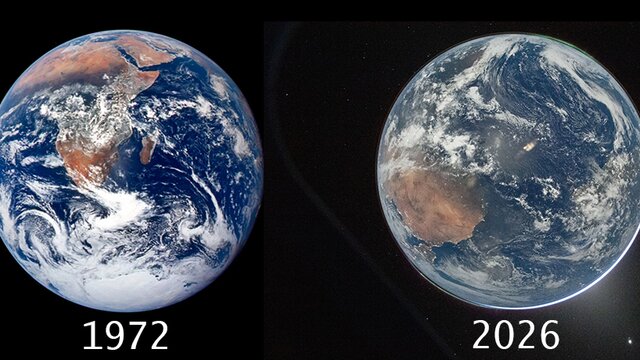
Internet users are discussing a new photograph of Earth published by NASA—the first human-made image of the planet from space in over half a century. Many are comparing it to a historic image from 1972 and concluding that Earth has changed.
The comparison is with the famous "Blue Marble" image taken during the Apollo 17 mission. Then, approximately five hours after launch, the astronauts saw the Earth fully illuminated by the Sun and took several photographs using a film camera. The resulting image became one of the most recognizable in history.
The modern image was taken under similar circumstances—during the Artemis II mission, as the spacecraft was heading toward the Moon. The crew commander used a digital camera, took a series of frames, viewed them on site, and immediately sent them back to Earth.
The difference between the two images is not only due to technological advances. While the 1972 images used film that was developed after the mission's return, the 2026 images were transmitted instantly via radio. The technical parameters—resolution, color rendition, and contrast—also differ significantly.
Furthermore, the images were taken under different lighting conditions. In this new case, the Earth was illuminated not directly by the Sun, but by reflected light from the Moon—a technology unavailable in the past.
Differences are also noticeable in the planet's appearance. The new image reveals a reduction in Arctic ice cover, shifting coastlines, and changes in vegetation and lake water levels.
However, it's difficult to assess these changes definitively. The Earth looks different, but the question of whether these changes are an improvement or a deterioration remains open.