Translated with AI

































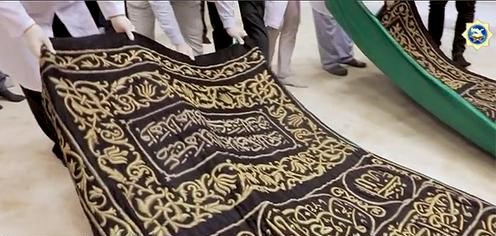
A portion of the kiswah—the covering used annually to decorate the doors of the sacred Kaaba—has been brought to Tashkent from Saudi Arabia, Fergana.ru reported, citing the press service of the Center for Islamic Civilization.
The kiswah was brought to Uzbekistan for the first time, at the initiative of President Shavkat Mirziyoyev. It will be part of the museum exhibition at the Center for Islamic Civilization, scheduled to open in late August of this year. The sacred artifact was received by a group of scholars and clergy led by the Center's director, Doctor of Art History Firdavs Abdukhalikov.
A kiswah is a black silk covering embroidered with gold thread that covers the walls of the Kaaba, the sacred stone structure in Mecca, considered the physical center of Islam. The covering is changed annually, and the removed pieces are cut into pieces and distributed to designated individuals, officials, museums, and organizations. The kiswah fragment sent to Uzbekistan is 6.3 meters long and 3.3 meters wide.
According to legend, the pre-Islamic custom of covering the Kaaba dates back to the Himyarite king Asad al-Kamil (4th-5th centuries). During the time of the Prophet Muhammad, the kiswah was made in Yemen; later, it began to be made in Egypt. In the first third of the 20th century, by decree of the first king of Saudi Arabia, Abd al-Aziz ibn Saud, a special weaving factory for kiswah production was established in the country. The factory employs approximately 200 male weavers.
The Center for Islamic Civilization is a project initiated by Uzbek President Shavkat Mirziyoyev to promote enlightened Islam as a religion of goodness, peace, and tolerance. The organization's building houses a unique museum consisting of five thematic halls.