Translated with AI


































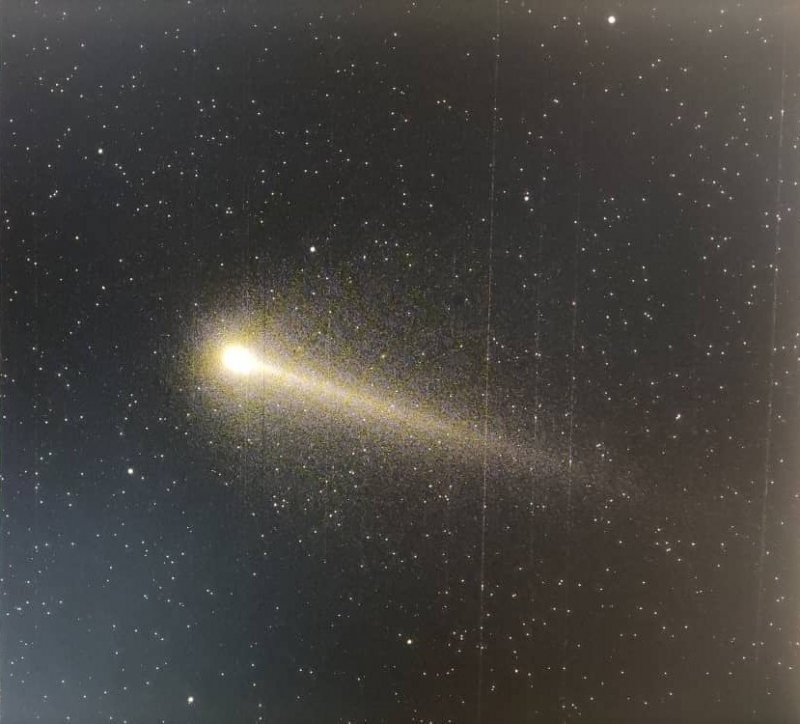
The Sanglokh International Astronomical Observatory of the Institute of Astrophysics of the National Academy of Sciences of Tajikistan is conducting observations of the periodic comet 220P/McNaught . Scientists are studying the unusual activity of the celestial body and the physical processes occurring in its coma and nucleus.
According to Firuza Rakhmatullaeva, a leading researcher at the Institute of Astrophysics of the National Academy of Sciences of Tajikistan, the observation program is aimed at studying the comet's activity and the processes occurring in its coma and nucleus, NIAT Khovar reported.
Comet 220P/McNaught is a short-period comet of the Jupiter family. Its orbital period is approximately 5.5 years . Comets of this family typically have their aphelia located near the orbit of Jupiter.
Due to its enormous mass, Jupiter exerts a significant gravitational influence on the motion of such small bodies in the Solar System, especially during their close encounters with the giant planet.
Comet 220P/McNaught was discovered on May 20, 2004, by Australian astronomer Robert McNaught at Siding Spring Observatory in Australia. According to its calculated orbit, the comet's previous perihelion passage occurred on December 10, 2020 .
However, in 2026, the comet exhibited unusual activity that attracted the attention of astronomers.
In late May–early June 2026, a powerful outburst from Comet 220P was recorded at the Palomar Observatory in California. At that time, it was approximately 1.6 astronomical units from the Sun.
After the outburst, the comet's apparent brightness reached approximately 8.2 stellar magnitude . This corresponded to an increase in its brightness of approximately 8,000 times .
On June 14, 2026, the comet passed perihelion at a distance of about 1.56 astronomical units from the Sun.
As the comet approached the Sun, a sharp increase in activity was observed over a relatively short period. This was accompanied by the formation of a pronounced coma and an extended ion tail.
However, by mid-June the comet's brightness had decreased to approximately 12th magnitude .
Of particular interest to researchers is the subsequent outburst of 220P, recorded in August 2026. During this period, the comet's brightness again increased sharply—by approximately 600 times .
According to scientists, a repeat episode of such a significant increase in activity is particularly valuable for observational studies. It allows us to trace the dynamics of cometary material and obtain information about the physical processes occurring near the comet's nucleus.
It is this rare phenomenon that Tajik scientists are currently studying at the Sanglokh International Astronomical Observatory.
The observations are being conducted under the supervision of Corresponding Member of the National Academy of Sciences of Tajikistan, Doctor of Physical and Mathematical Sciences Gulchekhra Kokhirova and on the initiative of Candidate of Physical and Mathematical Sciences Firuza Rakhmatullaeva.
The resulting images and photometric analysis results, according to Rakhmatullaeva, are of great scientific importance for clarifying the nature of the comet's observed activity.
In particular, they allow us to explore possible mechanisms for sudden outbursts. Among these, scientists are considering the destruction or collapse of individual sections of the core's surface under the influence of solar heating, the ejection of significant amounts of dust and gas, and the possible formation of stable nuclear fragments.
However, the presence of such long-lived fragments still requires further detailed observational confirmation.
Thus, observations of comet 220P/McNaught at Sanglokh provide an opportunity to study the evolution of cometary activity immediately after powerful outbursts, as well as to track changes in the morphology of the coma and tail over time.