Translated with AI



































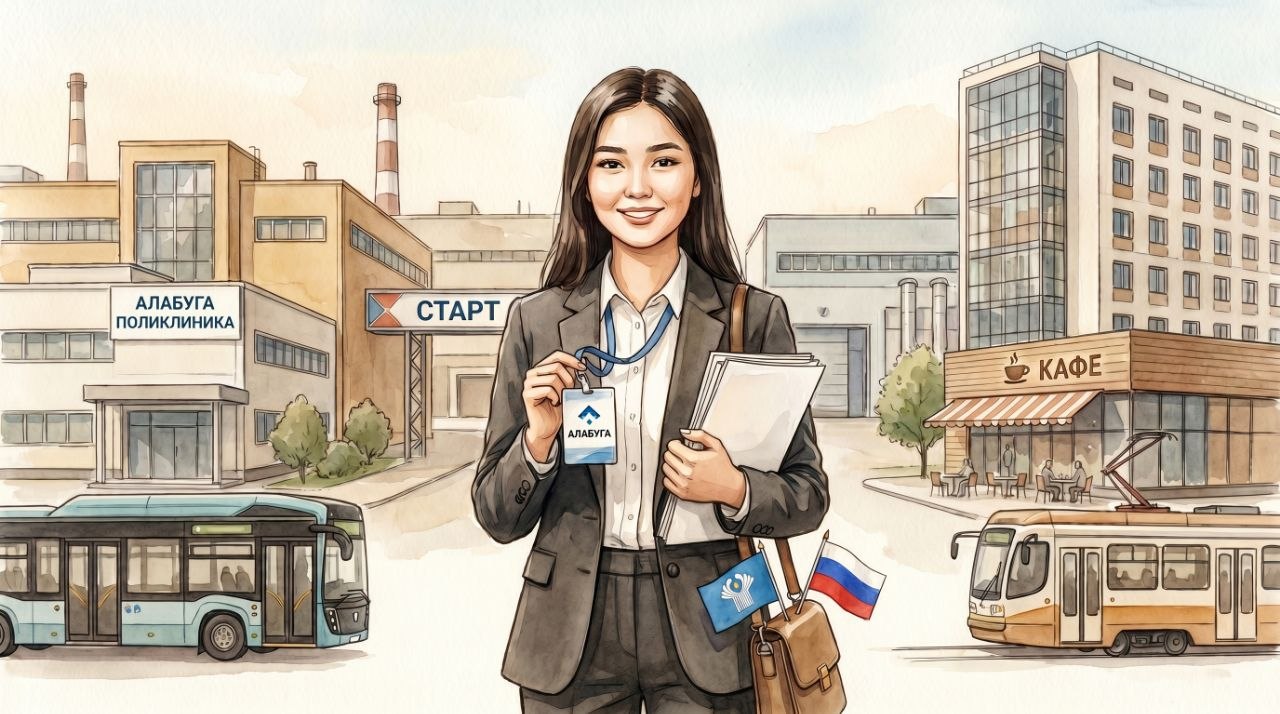
While Central Asian countries seek ways to expand opportunities for youth and women, the Russian labor market is already actively attracting specialists from the CIS. One of the most notable programs in recent years has been Russia's "Alabuga Start," which offers young women official employment, training, and career advancement in manufacturing, construction, and the hotel and restaurant industries. Amid growing competition for talent, such programs are becoming a real opportunity for many to launch independent careers outside their home country.
INITIATIVES OF CENTRAL ASIAN COUNTRIES
In April 2026, the European Union and the Government of Uzbekistan, with the participation of the United Nations Population Fund (UNFPA), officially launched a joint program, "Women's Economic Empowerment in Uzbekistan." It will be implemented from 2026 to 2028 and aims to promote gender equality and decent employment. The program includes investments in human capital, reproductive health, access to education, and entrepreneurship.
EU Ambassador to Uzbekistan Toivo Klaar emphasized that women's economic empowerment is not only a matter of equality but also a prerequisite for sustainable growth. Dr. Nigina Abaszada of UNFPA noted that women's economic empowerment is closely linked to access to healthcare and rights.
Ceren Güven Güreş of UN Women added that as Uzbekistan develops its economy, ensuring women's full participation in this process remains crucial.
At the same time, Kazakhstan is introducing its own instrument – the Altyn Visa. The decree was signed by Kassym-Jomart Tokayev. The reform envisages a transition from a permit-based system to an incentive-based one, transforming the country into a regional hub for talent and capital. Altyn Visa holders will receive long-term residency, access to government and financial services at a level similar to that of ordinary citizens, and exemption from personal income tax, property taxes, and land taxes.

Both initiatives—the Uzbek program with UN participation and Kazakhstan's Altyn Visa—testify to a growing understanding in Central Asian countries that competition for human capital is becoming a key factor in economic development.
RUSSIA: PATENTS, OPENNESS AND THE TATARSTAN PHENOMENON
Russia, for its part, remains the largest labor market for CIS citizens. A key legalization tool is a work permit, the cost of which varies by region. In 2026, the most expensive permit was in Krasnodar Krai – 27,283 rubles; in Moscow – 10,000 rubles; and in St. Petersburg – 8,000 rubles. One of the most affordable is in Tatarstan: the cost of a permit in Kazan (the regional capital) is 8,696 rubles; and nationwide, 7,937 rubles.
President Vladimir Putin has repeatedly emphasized the special nature of relations with the countries of Central Asia. In April 2026, at a briefing of the Security Council, he stated :
"We will discuss cooperation with our closest neighbors—the CIS countries. We have always had, and I'm sure will continue to have, a special attitude toward this," the Russian president noted. "Over the course of decades, we have developed special relations in both the humanitarian sphere and the human dimension: there are many mixed marriages, and many mutual interests in culture."

Earlier, at a press conference following the CIS summit, the Russian leader outlined his position very specifically: “Russia is, of course, interested in labor, but at the same time, we are interested in ensuring that this is the labor force we need.”
ALABUGA START: MORE THAN 80 COUNTRIES, SEVEN CAREER TRACKS, AND ABOVE-MARKET WAGES
Among these diverse initiatives, the "Alabuga Start" program, launched in 2022 in the Alabuga Special Economic Zone in the Republic of Tatarstan, deserves special attention. By 2026, it will cover more than 80 countries worldwide. The program offers participants aged 16 to 22 official employment in one of seven fields: logistics, production operator, finishing or installation work, catering, service and hospitality, and transport workshop.
For citizens of Central Asian countries, the program offers tangible benefits.
Firstly, there is no language barrier: Russian is either the second official language in most CIS countries or is widely used in everyday life, and participants do not need to spend time learning it.
Secondly, a full package of conditions: paid flights to Russia, discounted accommodation in corporate hostels ($44 per month), medical insurance, and official employment strictly in accordance with the Labor Code of the Russian Federation.
Third, there are clear career prospects: promotions with increased salaries are possible every six months. Financial benefits deserve special mention. Participants' starting income starts at $860 per month, a sum comparable to the salaries of qualified specialists in many countries in the region. As they advance in their career, their income increases.
DEVELOPMENT PROSPECTS FOR YOUTH IN THE REGION
While Uzbekistan, with support from the EU and the UN, is building an institutional framework for women's economic empowerment, and Kazakhstan is creating preferential conditions for skilled migrants, Russia is offering young people from the CIS countries an already functioning fast-track mechanism. A patent in Tatarstan is one of the cheapest in the country, and the "Alabuga Start" program provides a full range of support, from travel to professional development.

Competition for young talent is intensifying between countries in the region. And the winner is the one who offers not just a job, but a transparent growth trajectory from day one. For thousands of young women from Kazakhstan, Uzbekistan, Kyrgyzstan, and Tajikistan, the Tatarstan project is quietly but methodically changing the landscape of labor migration.