Translated with AI
































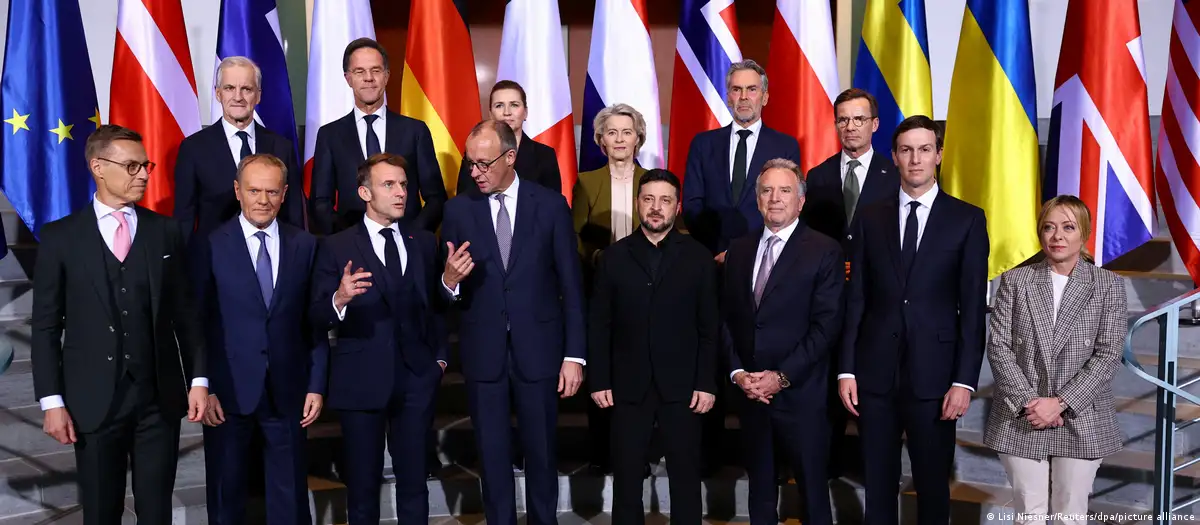
On December 15, 2025, Ukrainian President Volodymyr Zelenskyy held talks in Berlin with German Chancellor Friedrich Merz, representatives of the United States, and leading European countries on ending Russia's war against Ukraine. Leaders of the European Union, NATO, and representatives of European countries also participated in the talks.
At a press conference following the talks, German Chancellor Friedrich Merz noted that the territorial settlement remains the key issue. He emphasized that the final decision can only be made by the Ukrainian people and the Ukrainian president. This issue stems from Moscow's ultimatum to hand over the portion of Donbas not controlled by Russia after nearly four years of full-scale invasion. It is the most complex element of the previously agreed-upon "Trump plan," which Ukraine, together with its European partners, reduced from 28 to 20 points.
According to media reports, detailed plans have already been developed for most of the remaining points, including issues related to Ukraine's post-war reconstruction. Against this backdrop, the German-Ukrainian Business Forum held in Berlin discussed the possibility of resuming economic cooperation. German business representatives noted that not a single German company has left the Ukrainian market since the beginning of the war. Moreover, military cooperation is expanding: the German company Quantum-Systems announced plans to manufacture Ukrainian drones in Germany starting in 2026.
During the negotiations, the American side pressured Kyiv over the territorial issue, but, according to Zelenskyy, he was able to defend Ukraine's position. The president emphasized that he voiced the difference in positions with the United States so that the American side would convey this to Moscow. US President Donald Trump did not participate directly in the negotiations; his delegation was represented by Special Envoy Steve Witkoff and son-in-law Jared Kushner, with whom the Ukrainian side held hours-long talks on the "Trump plan."
One important outcome of the talks was progress on security guarantees for Ukraine. The United States presented specific proposals for legal and material guarantees, including legally binding mechanisms for action and arms supplies in the event of a new Russian attack. The possibility of providing guarantees comparable to Article 5 of the North Atlantic Treaty on Collective Security (NATO), while Russia insists on Ukraine's withdrawal from NATO membership, was also discussed. Ceasefire monitoring and measures to be taken in the event of a ceasefire violation also remain a subject for future negotiations.
In a joint statement, Ukraine's European allies proposed creating a US-backed multinational force to support a potential peace agreement between Kyiv and Moscow. This European-led force would contribute to the restoration of the Ukrainian Armed Forces, ensuring the security of Ukrainian airspace and maritime security, including conducting operations on Ukrainian territory.
The joint statement emphasized that the maximum peacetime strength of the Ukrainian army should be 800,000 soldiers to contain conflicts and protect the country's territory. Plans are underway to establish a US-led ceasefire monitoring mechanism with international participation, as well as to develop de-escalation measures. Europe has committed to taking legal action to restore peace and security in Ukraine in the event of a future armed attack, including the use of armed force, intelligence and logistical assistance, and economic and diplomatic action.
Chancellor Merz described the chances for peace as real, but still slim. It is still unknown when and in what form the results of the Berlin talks will be communicated to the Russian side, or whether this will happen after Ukraine, its European partners, and the United States finalize their positions. The main conclusion of Zelenskyy's visit to Berlin is that the negotiations have taken place and will continue.