Translated with AI

































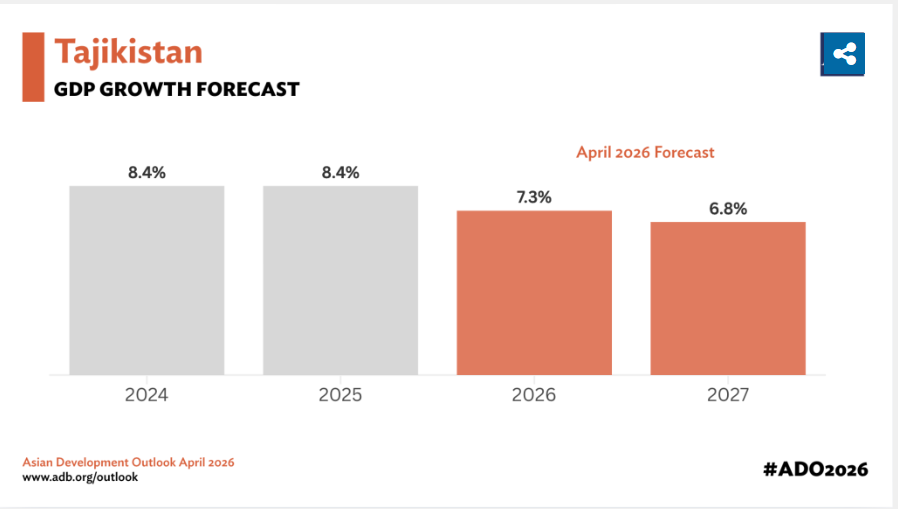
The Asian Development Bank forecasts that Tajikistan's economic growth will remain strong in 2026 and 2027, primarily driven by growth in industry and services, the bank's press service reported .
According to the Asian Development Outlook (ADO) economic report released in April 2026, the country's gross domestic product is expected to grow by 7.3% in 2026 and 6.8% in 2027. This compares to 8.4% growth in 2025.
The document also notes that inflation is projected to reach 4.0% in 2026 and 4.5% in 2027. Factors influencing price growth include increased consumer lending and remittances, higher public sector wages, supply chain disruptions, and adjustments to utility tariffs. It emphasizes that, given ongoing regional uncertainty, the forecasts may be revised.
ADB Country Director for Tajikistan Ko Sakamoto noted that strong economic growth creates opportunities for accelerated job creation. He stated that the development of competitive and high-income sectors—from food and textiles to mineral production—can contribute to an increase in the number of quality jobs, a key priority of the bank's partnership strategy with the country.
In recent years, industrial production in Tajikistan has demonstrated steady growth. However, the country's economy remains characterized by a narrow manufacturing base. Exports primarily consist of unprocessed raw materials and low- and medium-tech products. Industrial goods and high-value-added products account for less than 10% of total merchandise exports.
In this context, the Asian Development Outlook recommends the implementation of a comprehensive industrial development program based on an ecosystem approach. This approach involves coordinating measures across individual industries and addressing constraints across the entire business ecosystem, including infrastructure development, skilled labor training, increased access to finance, and improved business environments.
ADB is a multilateral development bank supporting inclusive, sustainable, and resilient growth in Asia and the Pacific. Founded in 1966, it is owned by 69 members, 50 of which are from the region.