Translated with AI
































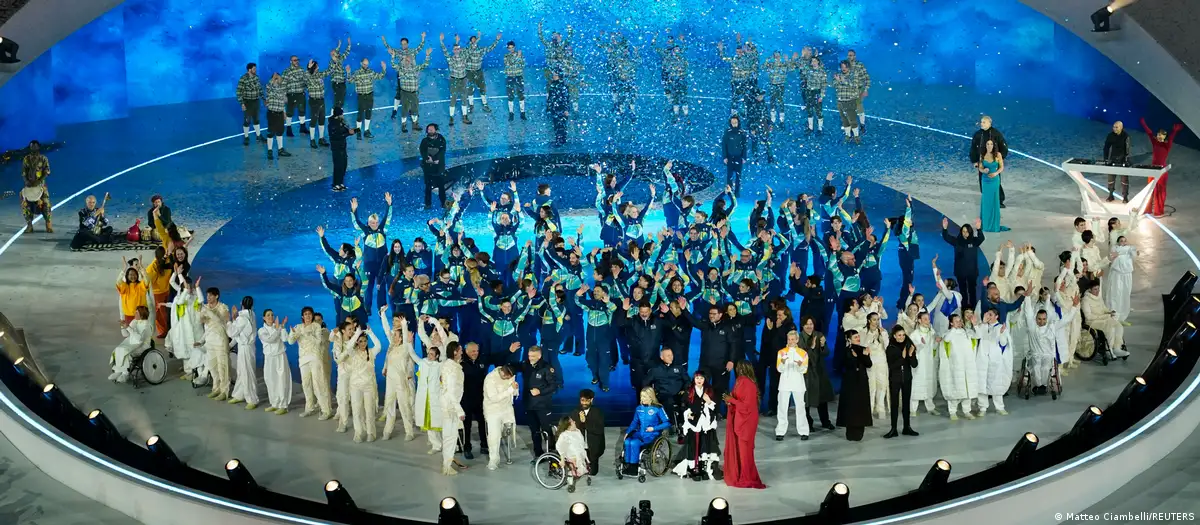
The XIV Winter Paralympic Games officially began in Italy on Friday, March 6. In the ancient amphitheater of Verona, 12 days after the end of the Winter Olympics, President Sergio Mattarella declared the Games open at 9:19 PM local time.
The Olympic flame was re-lit simultaneously in two places: at the Arch of Peace in Milan and in Piazza Dibona in Cortina d'Ampezzo.
Ukraine, the Czech Republic, Estonia, Finland, Latvia, Lithuania, and Poland boycotted the opening ceremony of the Winter Paralympics because athletes from Russia and Belarus were allowed to participate under their national flags, rather than as neutral athletes, as was the case at the 2026 Winter Olympics. The Russian athletes' entrance was met with boos from the crowd.
The Russian flag was carried at the ceremony for the first time since 2014. It was carried by a volunteer from Italy.
Teams from several countries, including Germany, France, Great Britain, and Canada, did not participate in the athletes' parade, citing sporting reasons. The German Association of Disabled Athletes cited their focus on upcoming competitions and expressed solidarity with the Ukrainians.
Germany sent 40 athletes and eight accompanying persons to the Paralympics. This is the second-largest German contingent in the history of the Winter Paralympic Games. Curling is the only sport not featuring German athletes.
On February 17, the International Paralympic Committee announced that athletes from Russia and Belarus will be able to compete in the 2026 Winter Paralympic Games in Milan and Cortina d'Ampezzo under their national flags. Six Russians and four Belarusians received bilateral invitations to the Paralympics.
In September 2025, the International Paralympic Committee reinstated the membership of the national committees of Russia and Belarus, which had been suspended following the outbreak of full-scale war in Ukraine. Formally, this decision allowed athletes from these countries to compete at the Games in Italy under their national flags. However, final eligibility depended on the international sports federations.
In December, the Court of Arbitration for Sport partially upheld the appeals of Russian and Belarusian athletes against the International Ski and Snowboard Federation's decision to disqualify them from international competitions. As a result, the Paralympic athletes were granted the right to compete in International Ski and Snowboard Federation competitions without neutral status and wearing national symbols.
Following this, Paralympians from Russia and Belarus were able to compete under their countries' flags at international competitions for the first time since the break. This was the FIS Cross-Country World Cup stage for athletes with disabilities, which took place in January in Finsterau, Germany.