Translated with AI
































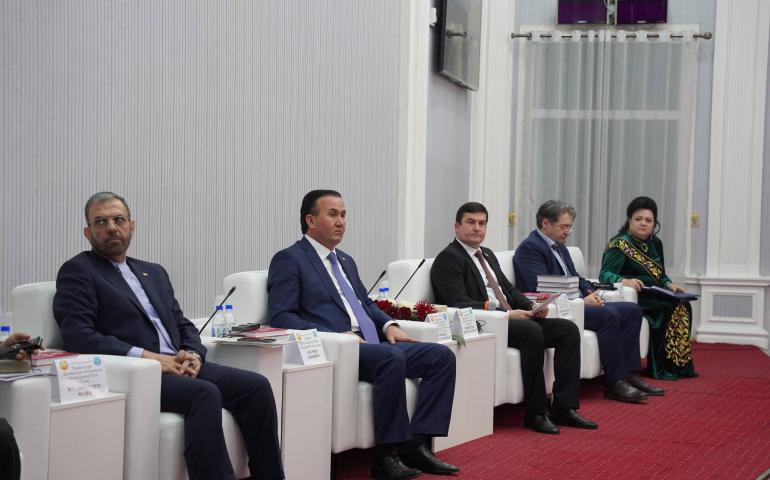
On November 4, an international symposium dedicated to the 1045th anniversary of the great Tajik scholar Abu Ali ibn Sina, known internationally as Avicenna, was held in the conference hall of the Presidium of the National Academy of Sciences of Tajikistan (NAST). This was reported by the press service of the Academy of Sciences of Tajikistan.
The symposium was attended by Assistant to the President of the Republic of Tajikistan on Social Development and Public Relations Rahmonzoda Abdullo Kurbonali, President of the National Academy of Sciences of Tajikistan, Academician Khushvakhtzoda Kabiljon Khushvakht, Ambassador Extraordinary and Plenipotentiary of the Islamic Republic of Iran to the Republic of Tajikistan Alireza Hakikyan, as well as a number of scientists and researchers who presented papers at the event.
The symposium was opened by the President of the National Academy of Sciences of Tajikistan, Academician Khushvakhtzoda Kabiljon Khushvakht, who emphasized that the Academy is proud to organize this event as part of the educational and scientific policy pursued by the President of the Republic of Tajikistan, Emomali Rahmon.
He noted that Tajikistan is deeply honored to host researchers and scholars from around the world in the birthplace of a great genius whose work continues to serve all of humanity. The symposium, entitled "Avicenna's Contribution to the Development of Science, Philosophy, and World Civilization," is being held in recognition of Ibn Sina's legacy.
Ibn Sina was reported to be one of the thinkers whose life and work are carefully studied by both modern and past scholars. The main goal of the symposium is to highlight Avicenna's achievements in the natural and mathematical sciences, as well as to demonstrate his role in the progress of world science.
Of all Ibn Sina's works, eleven are devoted to the natural and exact sciences. The most significant is the "Canon of Medicine" (Al-Qanun fi at-Tibb), consisting of five volumes translated into most European languages. This work provides a detailed account of medical theory, anatomy, physiology, surgery, diagnostics, treatment methods, pharmacology, and disease prevention.
Particular attention has been given to Ibn Sina's contributions to botany and chemistry. His work, "The Book of Plants" (Kitob ul-Naboth), lists over 500 medicinal plants. In chemistry, the scientist systematized inorganic substances and developed methods for conducting chemical reactions, significantly ahead of his time.
It was noted that Ibn Sina was also the founder of the philosophical rubaiyat, a genre of short poems in which he expressed philosophical, psychological and logical ideas.
Presidential Aide Rahmonzoda Abdullo Kurbonali emphasized that Ibn Sina was a rationalist, philosopher, physician, scientist, and encyclopedist who left behind an outstanding legacy that influenced the development of medicine and science for many centuries.
For his services to humanity, a monument to Ibn Sina stands in front of UNESCO headquarters, alongside monuments to Beruni, al-Razi, and Omar Khayyam. Since 2003, UNESCO has awarded the Avicenna Prize for Ethics in Science every two years, and a crater on the Moon bears his name.
From 2008 to 2015, the WHO supported the Avicenna Directory, a directory of medical universities and colleges worldwide. Today, it is known as the World Directory of Medical Schools.
During the symposium, cooperation agreements were also signed between the A.M. Bakhoddinov Institute of Philosophy, Political Science and Law of the Academy of Sciences of Tajikistan and the Institute of Oriental Studies of the Russian Academy of Sciences.