Translated with AI






























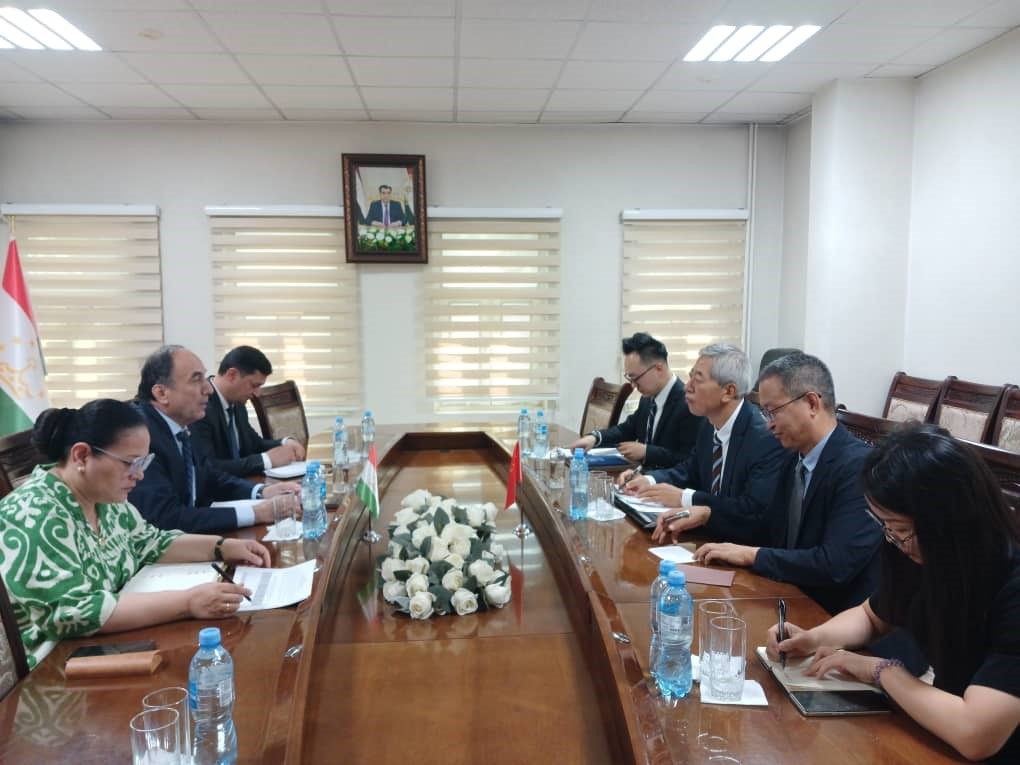
Tajikistan's Minister of Transport, Azim Ibrokhim, met with China's Ambassador Extraordinary and Plenipotentiary to Tajikistan, Guo Zhijun. During the meeting, the parties discussed the current state and prospects of bilateral cooperation in transport, international shipping, and the implementation of the Belt and Road Initiative, according to the ministry's press service.
The Minister of Transport of Tajikistan congratulated the ambassador on his appointment and expressed readiness to further deepen relations between the countries in the transport sector. Particular attention was paid to the construction of two-level highways at the intersection of Abay and A. Kahhorova, A. Jomi and A. Kahhorova, and Yuzhnaya and A. Kahhorova streets in Dushanbe. The feasibility study for the projects has been completed, and coordination with the Chinese side is currently underway. Following this approval, the drafting of tender documentation, and the selection of a contractor, the main construction work will begin.
The meeting discussed the China–Tajikistan–Uzbekistan–Turkmenistan–Iran–Turkey–Europe and China–Tajikistan–Afghanistan international transport corridors, as well as access through these countries to the seaports of Chabahar (Iran) and Karachi (Pakistan). The parties emphasized the importance of joint efforts to integrate transport infrastructure within the framework of the Belt and Road Initiative, proposed in 2013 by Chinese President Xi Jinping. Tajik President Emomali Rahmon was one of the first to support this initiative, which aims to create energy, transport, and trade corridors between China and the regions of Central Asia, Europe, and the Middle East.
The construction of the Dushanbe-Kulma highway between Kalaikhumb and Vanj, bordering the Rushan district, was highlighted as an example of cooperation within the initiative. The project includes the construction of 93 kilometers of roads, two tunnels with a total length of 5.2 kilometers, five avalanche corridors totaling 602 meters, 15 bridges totaling 633 meters, 21,850 meters of protective walls, and 151 artificial structures.
The parties also discussed promoting cooperation within international organizations such as the SCO, UNESCAP, and the CAREC program, as well as opportunities to increase transport and financial flows for the implementation of the National Development Strategy of Tajikistan until 2030 and the achievement of the Sustainable Development Goals.