Translated with AI
































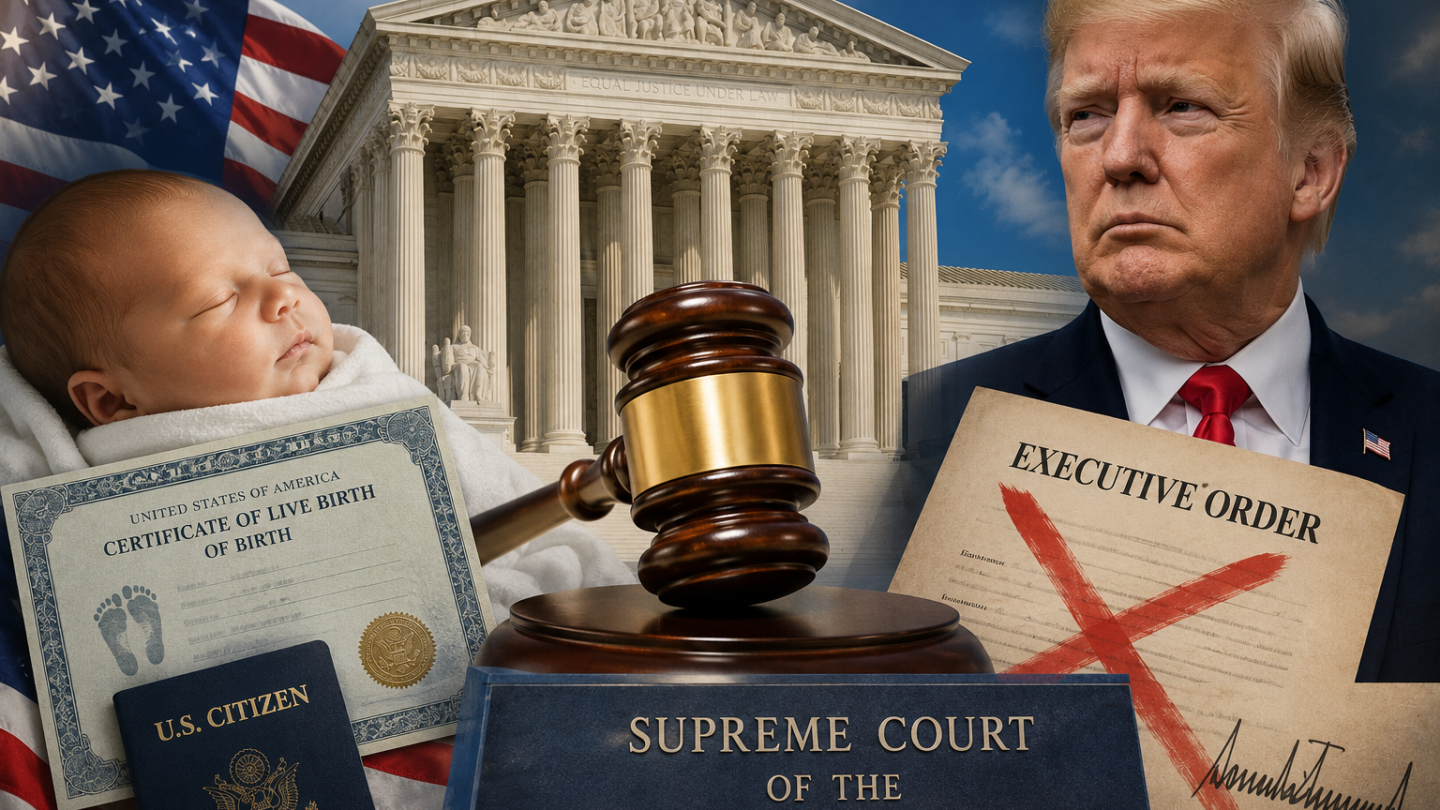
The US Supreme Court has affirmed that all people born on US soil are entitled to automatic American citizenship. The court thus rejected President Donald Trump's attempt to limit this constitutional principle, the BBC reports.
The decision was made by a majority vote: six judges opposed the presidential decree, three supported the administration's position.
Donald Trump signed an executive order restricting birthright citizenship in January 2025, shortly after taking office. The document sought to change the procedure for granting citizenship to children born in the United States if their parents were not citizens or did not have permanent residence.
Immediately after the decree was signed, several states and cities governed by Democratic Party representatives filed a lawsuit demanding that the document be declared illegal.
Initially, three federal judges attempted to block the order from taking effect. The U.S. Supreme Court later overturned their rulings, after which several court cases were consolidated into one. It was in this case that the Supreme Court issued its final decision.
Observers note that this trial was particularly significant for Donald Trump. In April, he personally attended the Supreme Court hearing, where U.S. Solicitor General John Sauer represented the administration's position.
The president's appearance at the hearing drew criticism from his opponents, who considered the move an inappropriate attempt to influence judges in a case of major importance to the country's domestic politics.
During the hearing, the justices subjected the administration's arguments to careful analysis. Even then, it became clear that the majority of the Supreme Court did not consider the administration's arguments sufficient to overturn birthright citizenship.
Donald Trump later publicly criticized the justices, saying that his Supreme Court appointees who vote against his position are "stupid people."
As BBC North America correspondent Anthony Zurker noted, the Supreme Court, citing the 14th Amendment to the US Constitution, has finally put an end to the administration's attempts to strip the birthright of children of undocumented immigrants and most foreign nationals temporarily residing in the country.
Chief Justice John Roberts, writing for the majority, said the text of the 14th Amendment, adopted shortly after the end of the American Civil War, leaves no room for ambiguity.
The Trump administration argued that undocumented immigrants do not fall under the definition of persons "subject to the jurisdiction" of the United States. However, John Roberts and the majority of the court rejected this argument.
Since the Supreme Court concluded that the US Constitution explicitly enshrines the right to citizenship by birth, changing this order is now only possible through a constitutional amendment. This is an extremely complex procedure, which has only been successfully completed 27 times in US history.
Birthright citizenship is based on the principle of jus soli ("right of the soil"), enshrined in the first sentence of the 14th Amendment to the U.S. Constitution. The document states that all persons born or naturalized in the United States and subject to its jurisdiction are citizens of the United States and of the state in which they reside.
Proponents of stricter immigration policies believe that this very provision encourages illegal immigration, as undocumented pregnant women come to the United States to give birth to a child and ensure the child's American citizenship.
The Fourteenth Amendment was adopted in 1868 after the end of the Civil War. While the Thirteenth Amendment abolished slavery, the Fourteenth established the procedure for granting citizenship to former slaves born in the United States.
According to Donald Trump's executive order "Protecting the Meaning and Value of American Citizenship," American citizenship was not to be granted to children whose mother was in the United States illegally and whose father was not a citizen and did not have the right of permanent residence.
Furthermore, the document extended the restrictions to children whose mothers were in the United States legally but temporarily. The administration explained this by arguing that birthright citizenship, in its view, only applies to individuals wholly subject to U.S. jurisdiction and does not apply to the children of undocumented immigrants.