Translated with AI
































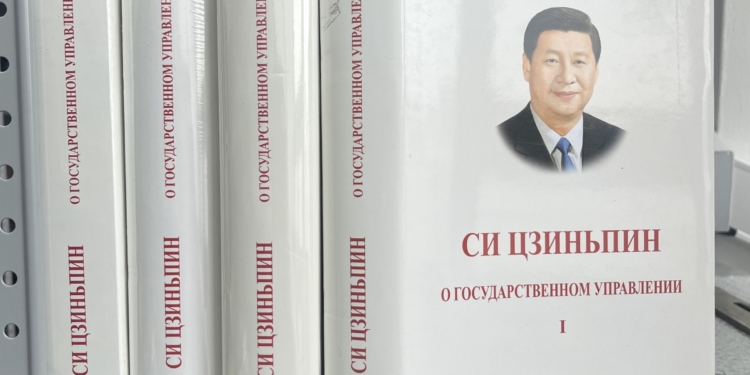
(Notes in the margins of the book by the General Secretary of the CPC Central Committee, Chairman of the PRC "On the Establishment of a Community of Shared Future for Mankind")
Recently, a friend of mine sent me this book from Dushanbe. "You're a staunch supporter of socialist ideas; you might find it interesting," he said. And he wasn't wrong. For several days, I spent time reading this unique book.
At the beginning, a quote from the book of the Kazakh scientist, historian and philosopher Seidakhmet Kuttykadam:
"The Celestial Empire—one of the most ancient and unique civilizations, the inventor of paper, gunpowder, printing, and the compass—has a continuous and turbulent history spanning five thousand years. It has often been torn apart by internal wars, and barbarians have repeatedly conquered it, establishing their dominance for long periods.
It faced particularly grave hardships at the very beginning of the 20th century. It became the target of aggression by eight powers—Germany, England, Japan, France, the United States, Russia, Austria-Hungary, and Italy—who imposed an oppressive protocol on it in 1901 and divided it into spheres of influence. China effectively became a semi-colony.
At this time, no one remembered the prophecy of Napoleon Bonaparte, uttered a century ago: “When China wakes up, the world will tremble!”
China has finally woken up, and the world has shuddered." (Seidakhmet Kuttykadam, Serving the Nation, Almaty, Book Club Publishing House, 2017, page 126).
Today, China is a superpower. For over fifty years, the world has been reeling from its greatest achievements.
I
During the first half of the twentieth century, when China became a semi-colony, the country was tormented by internal contradictions and robbed by foreign invaders.
In July 1921, the First Congress of the Communist Party was held in Shanghai, attended by 12 delegates. Back then, in the distant 1920s, no one could have imagined that this party, consisting of 50 members, would grow into a multi-million-strong political force and inspire the people to fight against colonial rule. The party's program for building socialism became a guide for the people, and the Proletarian Hymn "Internationale" inspired the struggle:
Arise, branded with a curse, The whole world is hungry and slaves! Our indignant mind is boiling And I am ready to fight to the death. We will destroy the whole world of violence To the ground and then We are ours, we will build a new one- He who was nothing will become everything. This is our last And the decisive battle; With the International The human race will rise again!
No one could have predicted that just six years later, in August 1927, the Communist Party, now a monolithic political force, would create the People's Liberation Army for a revolutionary struggle for freedom and independence. This struggle culminated in the founding of the People's Republic of China in 1949. The idea of building socialism under the leadership of the Communist Party became a national idea and united the people.
People from all over the world of different beliefs, different faiths, as well as those who hate communism, having visited the Celestial Empire, are amazed by what they see and are perplexed: how is this possible in a communist state?
I visited China twice. And I was glad—socialism isn't a thing of the past! Socialist China is becoming more and more attractive to all of humanity year after year.
Every year, thousands of young men and women from all over the world come to study in Shanghai, which has become a global educational center. And none of them pays attention to the fact that communist ideology is the dominant ideology in this country.
Education in China is about training and upbringing. It is based on moral principles and, above all, prepares citizens responsible for the fate of their homeland. Therefore, Chinese education is recognized internationally as the most effective and competitive.
II
"China has a one-party system!", "There is no democracy there!", "The communist regime violates human rights!" and so on and so forth. These are the Western media trumpeting these things, fooling their citizens.
What is Western democracy? "It's the power of money, created with money, for the sake of money!" (Mikhail Zadornov, Russian satirist.)
You couldn't have said it better! Capital elects politicians. These politicians, elected in "free," multi-party elections with capitalist money, serve the interests of those same capitalists like managers. The victory of a candidate in an election also depends on the amount of money the capitalists spend on them. The winner will be the one who has spent the most money. The payers in these elections are far from squeamish—they use the dirtiest techniques.
In underdeveloped countries, capitalists finance political parties to create a puppet parliament and a puppet president in order to extract cheap natural resources from these countries.
China isn't conquering the world through bloody coups, color revolutions, or carpet bombing, destroying entire countries and killing millions of people, as NATO countries led by the United States are doing. Over the past twenty years, the Americans have killed 38 million people to establish their monstrous democracy in various countries!
China is winning over the world with its appeal. Xi Jinping's idea of creating a community with a shared future for humanity is becoming increasingly popular. This idea runs through his book like a common thread.
Initiated by Xi Jinping in 2013, the global Belt and Road Initiative (BRI) to create infrastructure and economic corridors linking Asia, Europe, and Africa has generated considerable interest from the global community. This project affects regions home to approximately 63 percent of the world's population.
UN Secretary-General António Guterres stated that the goals of the BRI largely coincide with the UN Sustainable Development Goals and called on its participants to comply with international environmental standards.
The BRI is based on the principles of “joint discussion, joint construction, joint use” and provides benefits for all its participants.
III
The West hates China, and at the same time understands that harming China with sanctions means harming itself.
Bilateral trade between the US and China will reach $414.7 billion in 2025. Of this total, China's exports to the US account for $308.4 billion. China's imports from the US amount to $106.3 billion.
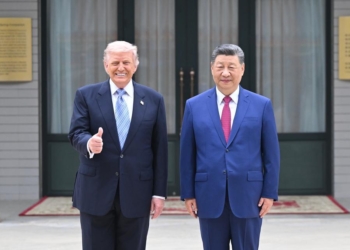
So Donald Trump, hiding his hatred of communism and communist China with a false smile, goes to Beijing to negotiate. And Xi Jinping, with his characteristic natural calm, greets him and declares, "Let's further develop our trade and economic cooperation!"
"China does not succumb to US dictates. And all NATO countries together cannot bring China to its knees! Wouldn't it be better for us to live in peace and develop mutually beneficial trade?" – this is how many experts commented on the Chinese leader's statement.
In 2025, mutual trade between China and the European Union will reach $828.11 billion! This is six percent more than in 2024. China's exports to Europe will grow by 8.4 percent, reaching $559 billion!
The main indicator of the stability of the economy of any country is when the volume of exports significantly exceeds the volume of imports.
These dry statistical figures indicate that the Western economy is largely dependent on trade relations with China, while China is less economically dependent on the United States and the European Union.
The West understands that hostile actions from outside only serve to strengthen the unity of China's multi-ethnic and multi-religious people. At the same time, it continues to attempt to foment interethnic and interreligious strife within the country.
IY
China is a superpower that does not threaten anyone, does not impose its ideology on anyone, and does not have military bases outside its territory.
China's foreign policy, based on five principles, was presented to the world community by Premier Zhou Enlai back in 1953: –mutual respect for sovereignty and territorial integrity; –mutual non-aggression and non-interference in each other's internal affairs; –equality and mutual benefit; –peaceful coexistence.
China continues to adhere to this policy to this day. Over the past 15 years, Xi Jinping, speaking in various parts of the world, has preached a philosophy of peaceful coexistence and, on this basis, the creation of a community with a shared future for humanity:
"Whether we can succeed in our pursuit of peaceful development largely depends on whether we can turn the world's opportunities into opportunities for China, and China's opportunities into opportunities for the world, and whether we can move forward in the process of positive interaction with countries around the world and achieve mutual benefit and win-win results," Xi Jinping said.
Today, more and more developing countries are becoming convinced that doing business with China is profitable and safe.
Y
*Taoism—Taoism—is one of the traditional philosophical and religious movements of China, which teaches living in harmony with nature and the universe. It is based on the concept of Tao (the way)—the eternal, impersonal, and omnipresent law of the universe, the fundamental principle and source of all existence.
Salomiddin Mirzorahmatov, political scientist, writer and historian