Translated with AI























Your Excellencies,
Distinguished Heads of Delegations,
Ladies and gentlemen!
First of all, I warmly welcome each of you to the ancient land of Tajikistan!
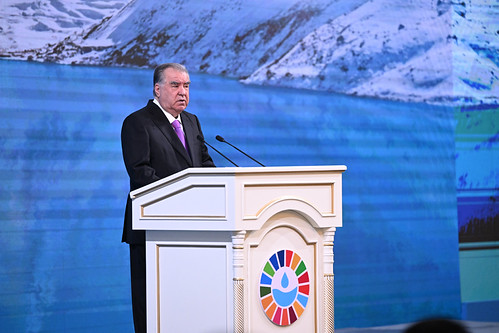
We are proud that today, within the framework of the Dushanbe Water Process, the Fourth International High-Level Conference on the International Decade for Action "Water for Sustainable Development, 2018–2028" is being held.
This conference furthers our shared commitment to strengthen cooperation and accelerate action to address one of the most pressing challenges of our time. We greatly appreciate your active participation and contribution to advancing the global water agenda.
Dear participants!
In recent years, Tajikistan has taken a number of practical measures to place water issues at the center of the international sustainable development agenda. In this regard, our country has consistently advanced its water initiatives, which have consistently found support in the United Nations General Assembly.
The core of our efforts is to enhance the value of water as an invaluable resource for life. Tajikistan consistently advocates for a balanced, inclusive, and results-oriented approach.
The proclamation of the International Decade for Action, "Water for Sustainable Development," is a clear demonstration of our joint efforts in this direction. Furthermore, the successful holding of the historic UN Water Conference in 2023, co-chaired by Tajikistan and the Netherlands, clearly demonstrated the need to accelerate global action on water.
As part of the Dushanbe Water Process, we continue our efforts to create an inclusive and transparent international platform and today, as per tradition, we once again brought together governments and other stakeholders from around the world to implement water-related commitments.
It must be acknowledged that, despite the progress achieved in the water sector, the world still faces a number of serious challenges that hinder the achievement of Sustainable Development Goal 6. Currently, billions of people lack access to safe drinking water and sanitation, and approximately 4 billion people experience at least a month of acute water scarcity each year.
Current trends indicate that these problems will significantly worsen in the future. According to new expert estimates, global demand for drinking water will increase by at least 25 percent by 2050, which, in turn, will require 50 percent more food production for the growing population.
At the same time, nearly half of the world's urban population could face water shortages. New and rapidly developing industries, including green manufacturing, urban development, food production, and digital infrastructure, will further increase demand for water resources.
This trend further exacerbates the need for a transition to water-saving technologies, efficient resource management, and better policy coordination across water, energy, and food sectors. Furthermore, the impacts of climate change, including droughts, floods, rapid glacier melt, and rising sea levels, are further exacerbating the current situation.
These factors place additional strain on already vulnerable systems. These indicators are not just forecasts, but a serious warning and a call to action for each of us.
Dear participants!
In order to address existing problems, Tajikistan is also taking necessary measures at the national and regional levels.
As part of the Water Sector Reform Program, the legal and institutional framework for the phased implementation of integrated water resources management has been significantly strengthened, and key infrastructure has been modernized, which is already increasing the efficiency and sustainability of water use.
To accelerate the achievement of Sustainable Development Goal 6, our country adopted the National Water Strategy until 2040 and the State Program for Drinking Water and Sanitation for 2025–2029.
These documents define long-term priorities and specific measures for water sector development. We intend to fully implement integrated water resources management at the national and regional levels by 2030, creating a modern, scientifically sound, sustainable, and effective system.
At the same time, we strive to ensure that at least 90 percent of the population has access to centralized water supply by 2040.
We intend to thus guarantee access to clean drinking water for every citizen.
Tajikistan also plans to increase the scale of water-saving technologies by more than forty times, turning the efficient use of this invaluable resource into a key tool for adapting to climate change.
Furthermore, we intend to increase the level of digitalization of water resources management to 80 percent by 2040, thereby ensuring transparency, efficiency, and sustainability of decision-making.
Dear friends!
We attach particular importance to the development of transboundary cooperation in the water sector.
We are making ongoing efforts to strengthen trust, partnership, and constructive dialogue in Central Asia to address key water issues. Tajikistan views the International Fund for Saving the Aral Sea as an important regional platform for discussing and addressing complex water issues for sustainable development.
In this regard, given the current challenges and needs of the countries in the region, we advocate for improving the structure of this fund and the creation within its framework of an Interstate Energy Commission of Central Asia.
This commission could become an important instrument for strengthening regional cooperation and ensuring sustainable development of the Aral Sea basin.
Dear attendees!
In recent years, the International Decade for Action "Water for Sustainable Development" and the Water Agenda for Action have created a solid foundation for addressing water challenges. However, despite this, we still face significant challenges in overcoming them for the planet's present and future.
To address these barriers, significant initiatives are being implemented around the world at national, regional and global levels to strengthen unity and cooperation in the water sector.
In this regard, we need balanced, effective, and inclusive measures that take into account common interests. Tajikistan believes that, to expand and practically implement these efforts, it is now imperative to move to a new stage of global cooperation in the water sector.
In this regard, we propose the creation of a "Dushanbe Framework Program on Water." This framework could strengthen current processes in the water sector and create a favorable basis for coordinating and consolidating joint efforts to achieve practical results.
Dear attendees!
We are approaching the final stage of the International Decade for Action, "Water for Sustainable Development." It is time to consider the global water agenda beyond 2030.
Our next steps in this direction must build on the achievements of the Decade, the Water Agenda for Action, and the experience of the Dushanbe Water Process, and be aimed at addressing increasingly pressing water issues.
I would like to remind you that a series of important high-level international events in the water sector awaits us, including the UN Water Conference in 2026 and the Sustainable Development Goals Summit in 2027.
In 2028, Dushanbe will host the UN Water Conference, which will summarize the current International Decade for Action, "Water for Sustainable Development." I am confident that the results of these events will contribute to shaping the global water agenda beyond 2030.
In this process, achieving practical results, sustainable financing, integrating water policy with the climate, energy and food agendas, as well as with ecological systems, along with strengthening regional and international cooperation, should become key areas of the new water agenda.
In this context, the Dushanbe Framework for Water will become the driving force for advancing the global water agenda beyond 2030.
Dear ladies and gentlemen!
Success on this path depends, above all, on reliable cooperation, a common understanding of the problems and the search for solutions.
Let us use the opportunity of today's conference as a turning point in addressing water issues. We all have a crucial shared responsibility: to rationally and effectively manage the planet's priceless treasure—water—for the benefit of present and future generations.
Dear attendees!
In conclusion, I would like to announce that the International Prize of the President of the Republic of Tajikistan in the field of water resources has been established in order to promote and strengthen water diplomacy, as well as to unite the efforts of the global community for a sustainable and secure future.
This award aims to recognize outstanding contributions to the development of international cooperation, scientific research, sustainable water policy and the promotion of effective solutions to global water problems.
Thank you for your attention.