Translated with AI































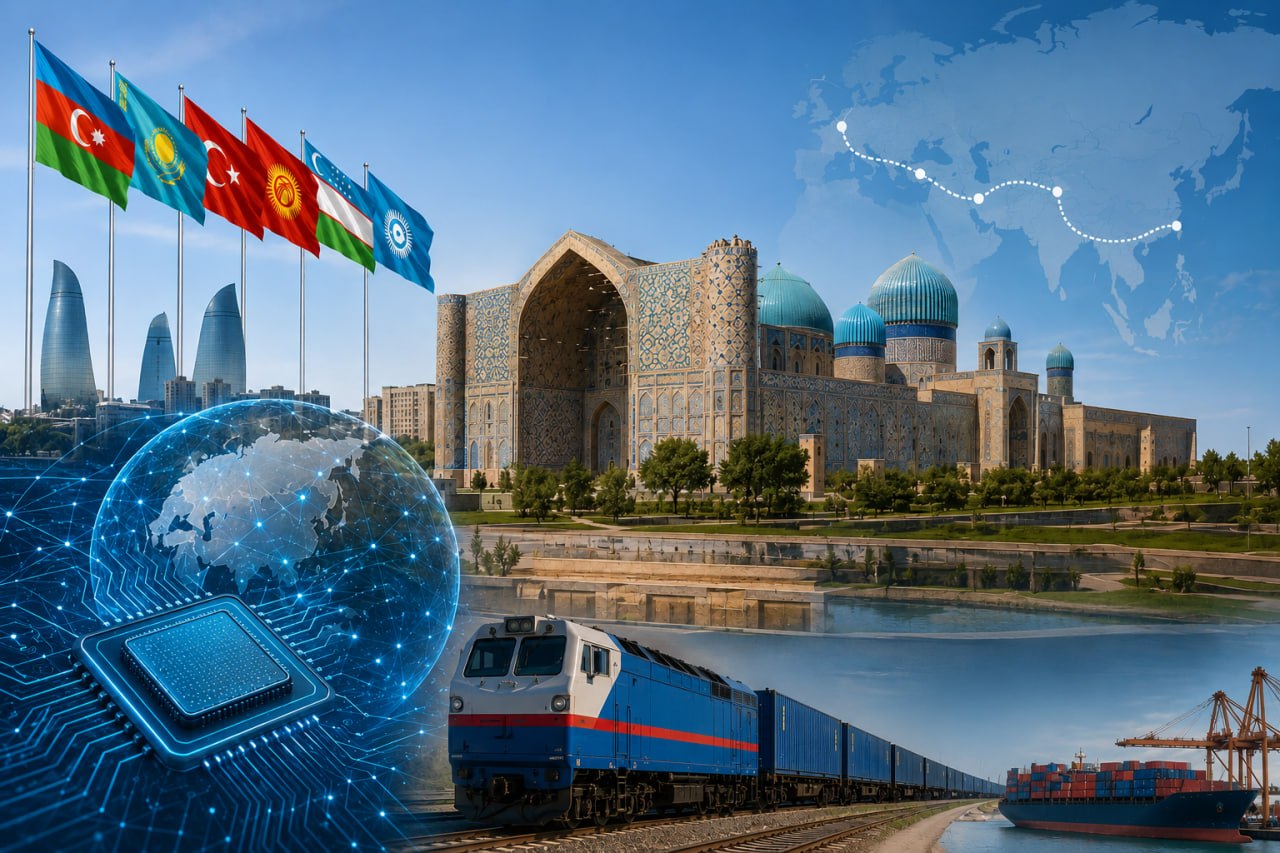
The informal summit of the Organization of Turkic States, which will take place on May 15 in Turkestan, demonstrates how rapidly the logic of Turkic integration is changing.
While just a few years ago the organization was primarily associated with humanitarian and cultural cooperation, today technology, artificial intelligence, transport corridors, and the digital economy are taking center stage. The Turkestan meeting reflects a new stage in the development of the amalgamated territorial community—one in which historical identity is gradually being complemented by the pragmatic nature of infrastructure projects and technological partnerships. Azerbaijan remains a key driver of this process, continuing to actively shape the agenda within the organization.
Turkestan and the new model of interaction within the amalgamated territorial communities
The informal summit format of the Organization of Turkic States emerged thanks to Azerbaijan's initiative. The first such meeting took place on July 6, 2024, in Shusha, a city that returned to Baku's control following the events of 2020. At that time, the leaders of the Turkic states adopted the Karabakh Declaration, outlining the common approaches of the OTG states to the post-conflict situation in the South Caucasus.
However, the significance of the Shusha summit proved to be much broader than the final document. In fact, it was then that a new diplomatic practice began to emerge within the organization: regular meetings of leaders in a less formal format, allowing for the discussion of strategic issues without the constraints of rigid protocol.
The next stage was a meeting in Budapest in May 2025, bringing together the leaders of all independent Turkic states. In 2026, Turkestan became the platform for continuing this dialogue.
The choice of the city has a profound symbolic meaning. Turkestan has long been considered one of the main spiritual centers of the Turkic world. It is home to the mausoleum of Khoja Ahmed Yasawi, the great 12th-century Sufi thinker whose legacy occupies a special place in the shared historical memory of the Turkic peoples. The complex is listed as a UNESCO World Heritage Site and is perceived as one of the most important symbols of a shared civilizational identity.
Therefore, holding a summit dedicated to digital technologies and artificial intelligence in Turkestan appears to be not just a diplomatic decision, but a well-thought-out political message: the Turkic world is attempting to build a bridge between its historical heritage and future technological development.
According to the press service of the Joint Territorial Community, the summit will be attended by the heads of state and government of member and observer states, including Hungary and Turkmenistan. A meeting of foreign ministers will also take place before the meeting of the Council of Heads of State. Source:
Artificial intelligence is becoming part of the Turkic strategy
One of the main topics of the meeting in Turkestan will be artificial intelligence and digital transformation. And this is no longer just a declarative agenda—the amalgamated territorial communities (ATCs) are gradually moving toward the development of a joint technological infrastructure.
Azerbaijan is particularly active in this area. The country is implementing its Artificial Intelligence Development Strategy for 2025–2028. The document covers several key areas: improving the regulatory framework, training specialists, developing data infrastructure, supporting scientific research, and expanding international cooperation.
An additional step was the opening of the Academy of Artificial Intelligence in Baku in September 2025, focused on training personnel and accelerating the digital modernization of both the public and private sectors. Source
One of the summit's central initiatives could be the creation of a common institute of artificial intelligence for the amalgamated territorial communities (ATCs). It is envisaged that such a structure will coordinate educational projects, technological developments, and digital transformation processes within the Turkic region.
In essence, this is no longer just a matter of political integration, but rather an attempt to create a sustainable technological platform that will operate regardless of changes in the international situation.
Kazakhstan, host of the summit, is also actively developing its own digital ecosystem. Astana Hub is currently positioned as one of the largest regional hubs for startups and innovation. Source
At the same time, Uzbekistan and Kyrgyzstan are modernizing their digital economy legislation. The relevant agreement within the Organization of Turkic States has already received the necessary approvals from relevant agencies.
The Middle Corridor as the Basis of New Eurasian Logistics
Along with technological development, the UTC states continue to actively develop transport integration. The central element here remains the Trans-Caspian International Transport Route—the Middle Corridor—where Azerbaijan plays a key role.
Over the past few years, the project has evolved from a political idea to a truly functioning logistics route.
By the end of 2024, freight traffic along the Trans-Caspian route had increased by 62%, reaching 4.5 million tons. Further growth was projected for 2025, reaching 5.2 million tons. Source
Container traffic through Azerbaijan increased by 19% in 2025, reaching 135,000 TEUs. Transit volumes increased by another 20%. Over 390 container block trains transited the China-Europe route alone.
Comparing the figures for 2022 and 2025, the total volume of traffic along the Middle Corridor has increased more than fivefold.
According to Boston Consulting Group estimates, transit through this route could increase three to fourfold in the coming years. By 2027, the Middle Corridor's capacity could reach 10 million tons annually. Source
Growing interest in the route is directly linked to changes in global geopolitics. Amid the risks of transit through Russia and instability in the Suez Canal region, the Caspian-Black Sea route is becoming one of the most sustainable alternatives for trade between Europe and China.
Speaking at the XIII Global Baku Forum in March 2026, Azerbaijani President Ilham Aliyev emphasized that the demand for transit through Azerbaijan continues to grow, and the country itself is becoming a key transport hub between East and West. Source
The Alat Port, the Alat Free Economic Zone, the Baku-Tbilisi-Kars railway, and the Baku-Tbilisi-Ceyhan oil pipeline collectively cement Azerbaijan's status as one of the key logistics hubs in Eurasia.
A major step in modernizing the route was the agreement between the railway administrations of Kazakhstan, Azerbaijan, and Georgia on the digitalization of freight transportation. Following the implementation of the new mechanisms, the time required to process transit documents through Georgia was reduced from eight to nine hours to forty minutes.
At the same time, the Middle Corridor is gradually becoming an instrument of political interaction. In October 2025, Azerbaijan opened transit for Armenian cargo. Later, fuel and fertilizer supplies from Russia began to pass through Azerbaijani territory. These steps are seen as part of a broader policy of post-conflict normalization in the South Caucasus. Source
Common alphabet and humanitarian integration
For the Organization of Turkic States, the year 2026 also holds significant symbolic significance. In addition to the summit in Turkestan and the meeting of the Council of Heads of State in Turkey, the organization is celebrating the centenary of the First Turkological Congress, held in Baku in 1926.
This congress brought together representatives of the intellectual elite of the Turkic world—scientists, historians, linguists, and educators from Central Asia and Anatolia—and is considered one of the most important events in the history of Turkic humanitarian thought in the 20th century.
It was Baku that became the space where a systematic discussion of the common cultural and linguistic identity of the Turkic peoples first began.
Azerbaijan's experience with the transition to the Latin alphabet also plays a special role in humanitarian integration. The country was the first among the post-Soviet Turkic states to definitively establish the Latin alphabet as its official language. Today, this experience is considered within the amalgamated territorial community as a possible model for linguistic modernization.
In September 2024, a meeting of the Commission on the Common Turkic Alphabet was held in Baku. Together with the Turkic Academy, representatives of the Turkic countries agreed on a draft of a unified alphabet based on 34 Latin letters.
Despite the complexity and political sensitivity of such processes, the work on the unification of writing itself demonstrates that integration within the amalgamated territorial communities is gradually moving far beyond diplomatic declarations and acquiring a full-fledged humanitarian content.
The Turkic world in search of a common model for the future
The informal summits of the Organization of Turkic States are gradually becoming a vital mechanism for strategic interaction within the organization. This format allows leaders to discuss sensitive and long-term issues in a more flexible and trusting atmosphere.
The practice initiated by Azerbaijan is already becoming one of the stable elements of the architecture of Turkic integration.
The Turkestan summit once again demonstrates that the amalgamated territorial community (ATC) today is no longer simply a political organization, but a space for shaping a shared future, where historical heritage becomes the foundation for technological development, and regional proximity becomes the basis for economic and infrastructural partnership.