Translated with AI


































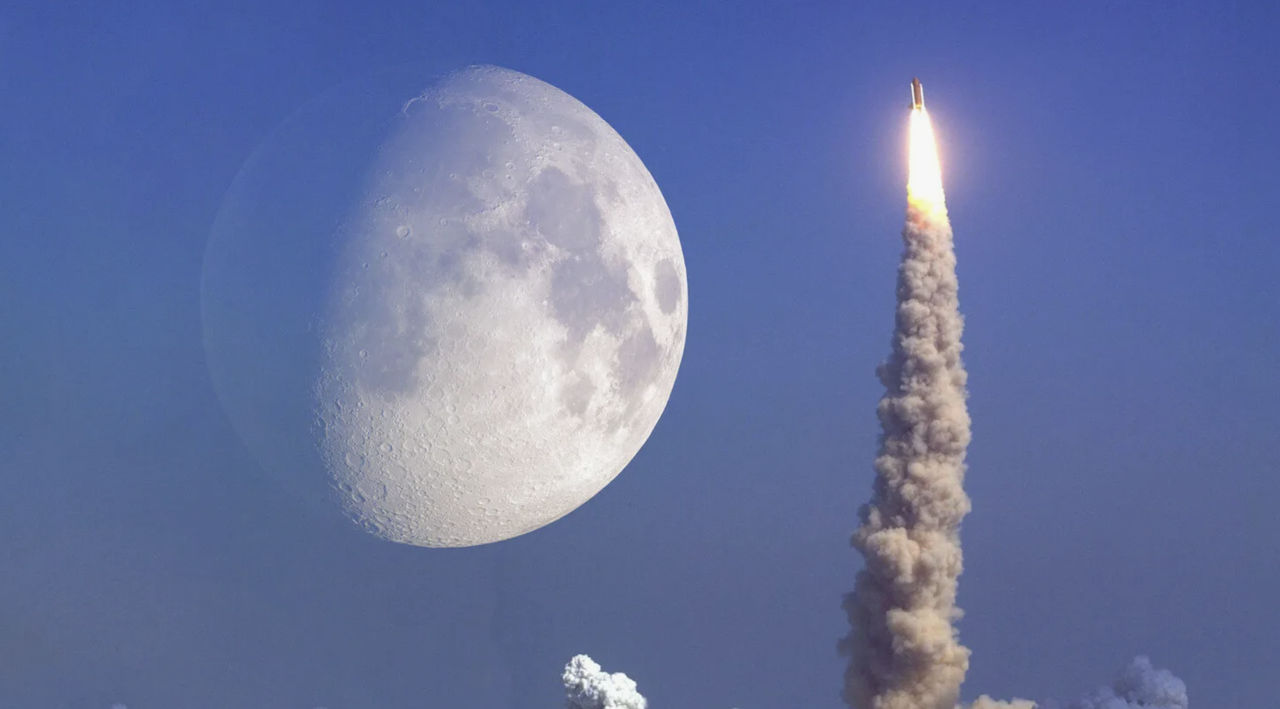
A new lunar race has unfolded as the United States, China, and other countries compete for lunar resources, including ice and helium-3, as well as for the right to establish permanent bases on the moon, The New York Times reports.
According to the publication, NASA and other space agencies, including China and India, are considering the Moon as a source of ice and helium-3, as well as a possible future outpost in deep space.
During the first wave of lunar exploration, NASA and the Soviet Union focused on the near side of the moon, where direct radio communication with Earth was possible. Currently, space agencies are showing increased interest in the Moon's poles and its far side, which is beyond direct visibility from Earth.
Ice in the craters at the Moon's poles could be used to produce drinking water, oxygen, and rocket fuel. Helium-3, extremely rare on Earth and valued at approximately $9 million per pound, is considered a promising fuel for fusion power. The far side of the Moon, in turn, could become a site for radio telescopes shielded from terrestrial radio interference.
Washington plans to build a base near the Moon's south pole, while China has also announced its intention to establish its own outposts in the region. NASA's updated roadmap for the next decade calls for a transition from short-term expeditions to the creation of permanent infrastructure on the Moon, including power supply systems, communications, transportation, and possibly small nuclear power plants to support a long-term human presence.
The Moon Race is a competition among scientifically and technologically advanced countries for the lead in exploring the Moon, Earth's only natural satellite. It is part of the broader space race, which includes projects to explore Mars, asteroids, and the outer planets of the Solar System.
The first stage of the lunar race spanned the period from 1958 to 1978, when the United States and the USSR conducted 59 and 58 lunar missions, respectively. In December 1968, the Apollo 8 mission launched three astronauts into lunar orbit for the first time, and in July 1969, astronaut Neil Armstrong, as part of the Apollo 11 mission, made the first landing on the moon. A total of 24 US astronauts were sent to the moon, 12 of whom landed and worked on the moon's surface.
A new stage in the intensification of lunar exploration is associated with the discovery in 2009 by the Indian probe Chandrayaan-1 of water ice deposits at the satellite's poles, which opened up the possibility of producing oxygen and rocket fuel.
NASA's new Artemis lunar program has been in operation since 2017. As part of this program, the Orion spacecraft was launched from Cape Canaveral, Florida, on April 1. The Artemis II mission, designed to last ten days, will fly by the far side of the Moon without landing on the surface. The spacecraft will pass within approximately 8,000 kilometers of the moon.
Three NASA astronauts are on board the spacecraft: crew commander Reid Wiseman, pilot Victor Glover, specialist Christina Koch, and Canadian Space Agency astronaut Jeremy Hansen. They claim to have seen the far side of the Moon.
The United States hopes to return humans to the Moon by 2028, two years ahead of China's goal, but NASA acknowledges it may not be the first. China remains the only country to have landed and returned samples from the far side of the Moon. China's seventh robotic mission, Chang'e 7, is expected to launch this summer, exploring the lunar south pole.