Translated with AI


































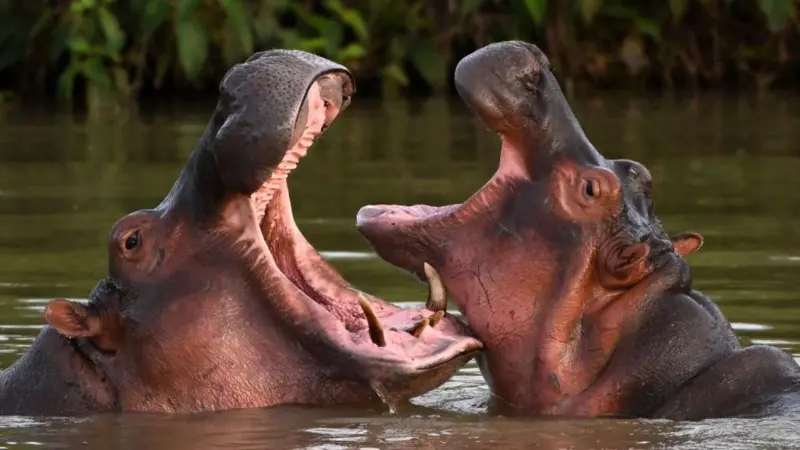
Colombian authorities are considering culling some of the so-called "cocaine hippos" brought to the country by drug lord Pablo Escobar in the 1980s. The animals were initially kept in a private zoo on the grounds of the Hacienda Napoles estate, but after Escobar's death in 1993, they were left unchecked and began to proliferate, the BBC reports.
According to research, the current hippopotamus population may reach 250 individuals. Authorities have announced plans to cull up to 80 animals to curb the population growth.
Environment Minister Irene Velez stated that without such measures, it will be impossible to control animal populations, and such actions are necessary to preserve ecosystems.
Scientists in Colombia have long argued that culling animals in the wild is the only way to mitigate their environmental impact. The main problem is that hippos are not native to the Latin American country—or anywhere outside of Africa, for that matter.
The main consequence of this is that they have no natural enemies such as lions and crocodiles, and they can reproduce almost without limit.
The decision drew criticism from animal rights activists. Senator Andrea Padilla called it cruel and stated that she does not support the destruction of healthy animals, which she said were victims of state irresponsibility.
Scientists emphasize that hippos are an invasive species in Colombia because they have no natural predators outside of Africa. This allows them to reproduce uncontrollably. Biologist Natalie Castelblanco noted that without intervention, the situation could spiral out of control within the next 10 to 20 years.
Castelblanco explains that the "cocaine hippos" took advantage of another evolutionary opportunity that goes beyond the lack of predators to keep their numbers down: the weather.
Africa experiences severe dry seasons, which also help control population numbers. The Magdalena River basin experiences constant rainfall, making conditions so ideal for hippos that they appear to mature earlier and begin producing young at a younger age.
After Escobar's death, his estate was confiscated, and the zoo's animals were distributed to other institutions. However, the hippos were left behind due to the difficulty of transporting them. As a result, they survived and formed the largest population outside of Africa.
Experts estimate that without control measures, the animal population could exceed 1,400 individuals by 2034. One study notes that to prevent this, approximately 30 animals need to be culled or sterilized annually.
Scientists warn that hippos could have a negative impact on the ecosystem, displacing endangered native species and altering water chemistry, which could impact fisheries.
Moreover, the animals pose a potential danger to humans. Despite no fatalities in Colombia, hippos kill approximately 500 people annually in Africa—more than lions, crocodiles, or elephants.
Some experts oppose culling and propose alternative measures such as sterilization. However, according to veterinarian Carlos Valderrama, such operations are complex, dangerous, and expensive, especially considering that many of the animals live in the wild. In 2009, he castrated a male "cocaine hippopotamus" as part of an experiment to study ways to control the growing population.
"We're talking about an animal that can weigh five tons and be very aggressive," says Valderrama. "Even though we sedated the animal, it nearly knocked over the crane we were using to perform the procedure. It was like being next to a dinosaur in Jurassic Park."
The veterinarian says the main lesson from the experiment was that simply castrating, especially given the $50,000 cost of the surgery, is not an option.
"Many of these hippos live in the wild. It's simply impossible to easily reach them all. And they will continue to reproduce. Hippos are polygamous, meaning one male can impregnate many females," adds Valderrama.
Authorities previously attempted to relocate hippos to zoos, but these efforts proved ineffective, in part due to high transportation costs. Returning the animals to Africa was not considered due to the risks to local ecosystems.
Public opinion remains a significant factor. After the shooting of a hippopotamus named Pepe in 2009, public outcry led to the introduction of legal protections for these animals.
According to biologist David Echeverri, the situation has reached a level where culling is considered a necessary measure, although not the only one.
According to official data, only four individuals were sterilized between 2011 and 2019.
Experts warn that the hippo population remains an "ecological time bomb" whose effects continue to be felt more than 30 years after Pablo Escobar's death.