Translated with AI


























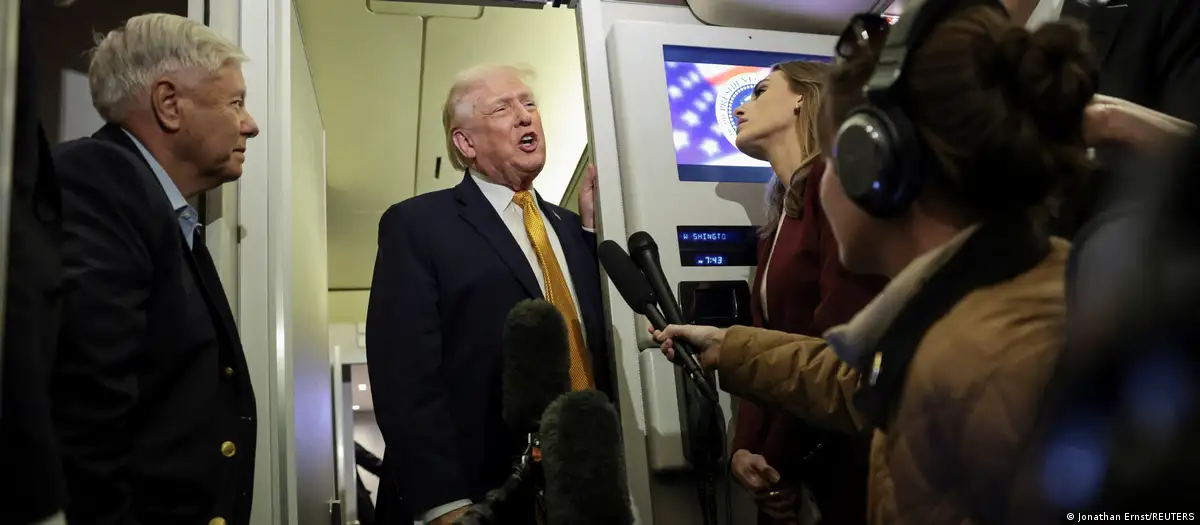
US President Donald Trump said he does not believe Russian authorities' claims about an alleged attempt by the Ukrainian Armed Forces to attack Russian President Vladimir Putin's residence in the Novgorod region in late December are credible. The American leader made this statement while speaking to reporters aboard Air Force One on Sunday, January 4.
One of the presidential pool journalists, asking Trump a question, recalled his earlier sharp reaction to reports of a possible Ukrainian airstrike on Putin's residence in Valdai. Trump interrupted her and stated that he didn't believe the attack had even occurred. He added that after checking the information, Washington found no confirmation of Moscow's claims.
When asked why he publicly condemned the possible attack, the US president explained that there was no verified information at the time. "Nobody knew anything back then. That was the first I even heard about it. He said his house had been attacked. Later, when we verified the information, we didn't believe it," Trump remarked.
During the same briefing, journalists asked whether the US administration had set a deadline for ending Russia's war against Ukraine. Trump responded that there was no specific deadline, but he hoped for a swift end to the conflict.
The issue of possibly tightening sanctions pressure on Russia was then raised. In response, the US President invited Republican Senator Lindsey Graham, who was also on board the plane, to speak. "We discuss this every day," Trump said, addressing the senator.
Lindsey Graham stated that, in his view, peace in Ukraine can be achieved by increasing economic pressure on Russia and its partners. He noted that this involves imposing tariffs on countries that continue to purchase Russian oil. The senator recalled that the Trump administration had already imposed sanctions against major Russian oil companies in October, but, he added, Moscow still retains a significant number of economic partners.
Graham reported that legislation is being discussed in the US that would allow the president to impose tariffs of up to 500 percent on products from countries purchasing Russian oil. As an example of the effectiveness of such measures, the senator cited India, which, he claimed, reduced its purchases of Russian oil after the imposition of US tariffs. Trump, for his part, added that, in his assessment, Russia's economy is currently in dire straits.
Russian authorities' claims of an alleged attack on Vladimir Putin's residence came amid Ukrainian President Volodymyr Zelenskyy's visit to the United States, where he discussed possible steps to resolve the conflict with Donald Trump. Zelenskyy had previously stated that such reports from Moscow could be aimed at paving the way for strikes on Kyiv and other Ukrainian government facilities, as well as disrupting the negotiation process.
Later, Donald Trump posted a link to a New York Post article on Truth Social with a headline that claimed Moscow's claims of an "attack" merely demonstrated that Russia was blocking peace.
On January 1, the Russian Ministry of Defense announced it had acquired the controller of one of the Ukrainian drones it claimed participated in the attack on Vladimir Putin's residence in Valdai. Russia announced it had handed over the controller to the United States. However, judging by Donald Trump's recent statements, these actions have not changed his skepticism of Moscow's claims.