Translated with AI


































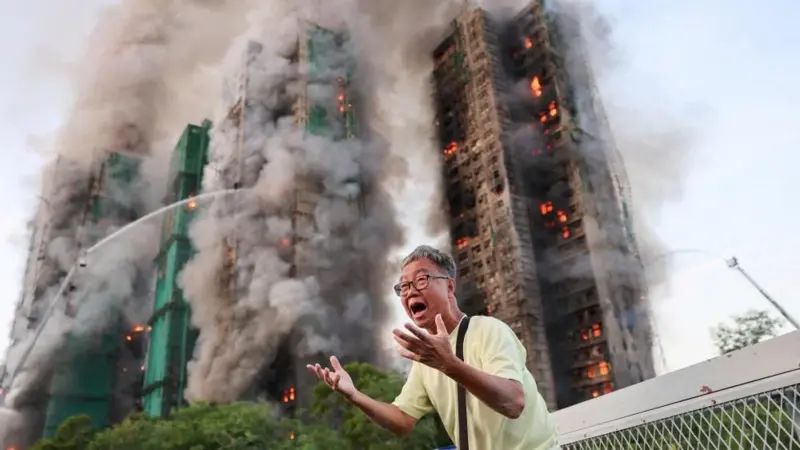
As the world's population grows, the number of high-rise buildings in major cities around the world is growing. Following the fire in Hong Kong, which killed more than 150 people, millions of people who live or work in high-rise buildings may be wondering what to do if a fire breaks out in their home, the BBC reports.
"The taller the building, the further its occupants are from absolute safety during a fire," Ben Levy, head of the tall buildings fire safety group at the UK's National Joint Fire Chiefs' Council, told the BBC.
According to him, there are several basic steps that high-rise residents can take to improve their chances of survival in a fire.
"If there's a fire near you, make sure you're safe, warn others, and then call emergency services. Don't assume someone else has already done this. Every second counts during a fire. The sooner the fire department learns of the fire, the sooner they can dispatch help, which will save more lives," emphasizes Ben Levy.
"Secondly, remain calm. Don't run. Move in an organized manner to the nearest fire exit," advises Ben Levy. Organized actions and a calm demeanor will help avoid blocking escape routes. Chaotic movement and panic will only hinder firefighters' rescue efforts, the expert notes.
"First, make sure you're safe yourself, and if possible, help those who may have mobility issues," says Ben Levy.
The main problem in high-rise buildings, where the only reliable escape route is usually down the stairs, is congestion as the flow of people from each floor merges into narrow stairwells.
Descending stairs during a real evacuation occurs much more slowly than expected. During drills and in everyday life, people descend stairs at a speed of approximately 0.4–0.7 meters per second. But in a real emergency, especially during fires in high-rise buildings, this speed can be significantly lower.
Fatigue is a significant factor affecting the speed of descent. The length of the walk significantly impacts speed. And the vast majority of those evacuated from high-rise buildings stop at least once to rest.
During the 2010 Shanghai high-rise fire, nearly half of the elderly survivors said their speed gradually but significantly decreased during descent.
Steady pace The pace of evacuation may be further slowed by the understandable desire of families to stick together rather than walk in a crowd of people. Children and the elderly tend to move slowly, which slows down the entire family's descent.
"My research shows that when people walk in families, they literally create closed polygons, even on stairs," Milad Haghani, a professor at the University of Melbourne in Australia and an urban environment specialist, told the BBC.
This means there's a lot of unusable space between them. This, in turn, can create congestion and slow down overall traffic during evacuations.
"If family members or a group of people descend together, holding on to each other's clothes, for example, or, if they can, to the railing, this significantly speeds up the movement, as experiments show," says Ben Levy. He adds that it can even be helpful to count out loud together: "One, two, three, four…" to maintain a steady pace.
When descending, one must take into account that firefighters may be climbing up the same stairs, the expert notes.
Experts agree that preparation is key to a successful evacuation from a high-rise fire. Knowing the location of fire escapes and the building's overall layout can be vital. Fires often break out at night, so a clear understanding of the location of escape routes can be crucial to a successful rescue.
Instead of always taking the elevator down to the ground floor, try taking the stairs every now and then, as Ben Levy recommends.
"Feel what it's like to walk down the stairs, and do it before you need to in an emergency," he says.
Milad Khagani, in turn, notes that people tend to “freeze,” to become numb when an emergency arises, rather than act.
"It's natural for many people to freeze in confusion when they hear the sound of a fire alarm and the announcement of a fire," the researcher told the BBC.
"Usually, those who react quickly are the ones who survive. This depends on how well they understand fire evacuation procedures and how regularly they participate in drills," says Milad Hagani.
Levy also emphasizes the importance of ensuring maximum building security.
"We all assume that our buildings are safe and built to approved standards," he says.
"Fire protection principles, particularly the presence of fire doors, compartmentalization, and structural integrity, must be adhered to. This ensures the safety of building occupants, sufficient to allow for evacuation. Unfortunately, we too often see examples of high-rise buildings around the world not adhering to these standards," emphasizes Ben Levy.