Translated with AI
























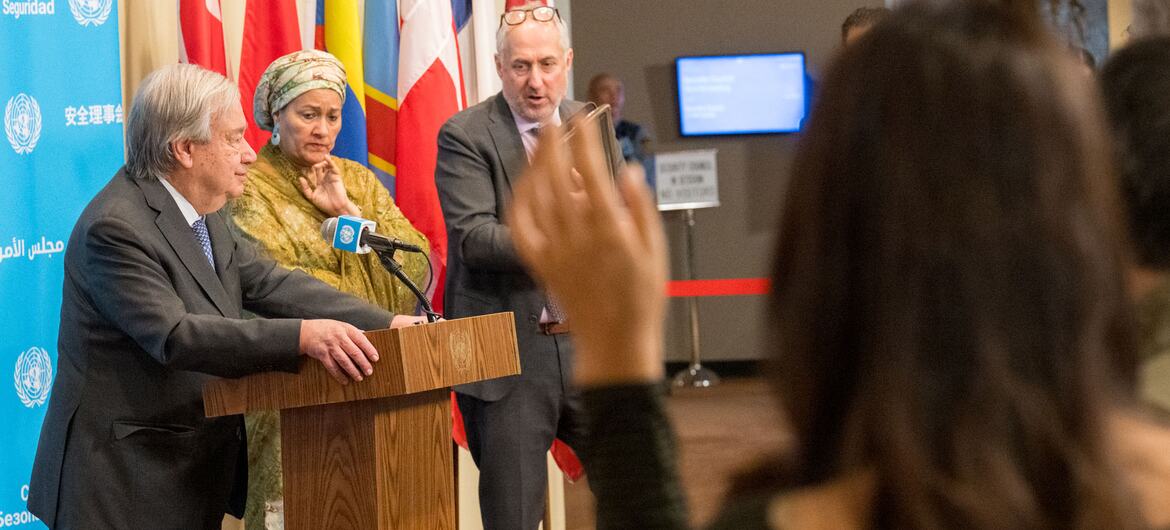
UN Secretary-General António Guterres stated that the situation in the Strait of Hormuz remains critical despite the declared ceasefire. He made this announcement at a press conference at UN headquarters in New York.
According to him, restrictions on freedom of navigation are already having a serious impact on the global economy, disrupting oil, gas, and fertilizer supplies. Guterres emphasized that the consequences of the conflict affect the entire global community.
The UN chief presented three possible scenarios for the situation. In the most favorable scenario, if restrictions are lifted in the near future, global economic growth will decline from 3.4% to 3.1%, and inflation will reach 4.4%. However, the restoration of supply chains could take several months, and the growth rate of global merchandise trade will slow to approximately 2%.
According to the second scenario, if disruptions persist until mid-year, economic growth could slow to 2.5% and inflation could rise to 5.4%. In this case, approximately 32 million people would fall below the poverty line, and another 45 million would face extreme hunger.
The worst-case scenario assumes that restrictions will remain in place until the end of the year. In this case, inflation will exceed 6%, economic growth will decline to 2%, and the global economy could face the threat of a global recession.
Guterres called on the parties to immediately restore freedom of navigation in accordance with the UN Security Council resolution and to refrain from actions that could undermine the ceasefire.
He also reported that the International Maritime Organization is developing a plan to evacuate ships and seafarers. UNOPS Director General Jorge Moreira da Silva is heading to the region for consultations on establishing a humanitarian corridor, and the Secretary-General's personal envoy, Jean Arnault, is continuing negotiations with the parties to the conflict.
Meanwhile, Dario Liguti, a representative of the UN Economic Commission for Europe, reported the serious consequences of the crisis for the energy market. According to him, global liquefied natural gas supplies have fallen by 20% due to restrictions in the Strait of Hormuz and infrastructure disruptions, including the Ras Laffan complex in Qatar. This has led to price increases: by 140% in Asia and by 70% in Europe.
The crisis is having its most significant impact on countries in South and Southeast Asia, but its consequences are also expected in Europe, especially as the winter season approaches.
The crisis has also affected the fertilizer market: approximately a third of global supplies are at risk, and prices in some regions have risen by 50%. This could negatively impact the upcoming agricultural season.
Furthermore, supplies of liquefied propane, widely used for cooking in Asian countries, are declining. In particular, a significant portion of India's household fuel arrives through the Strait of Hormuz.
According to Liguti, the current situation highlights the vulnerability of the global energy system and its dependence on fossil fuels. He called for an accelerated transition to renewable energy sources, increased energy efficiency, and more efficient use of resources.
The UNECE emphasizes that the energy system must be considered holistically – from production to distribution, storage and final consumption.