Translated with AI
































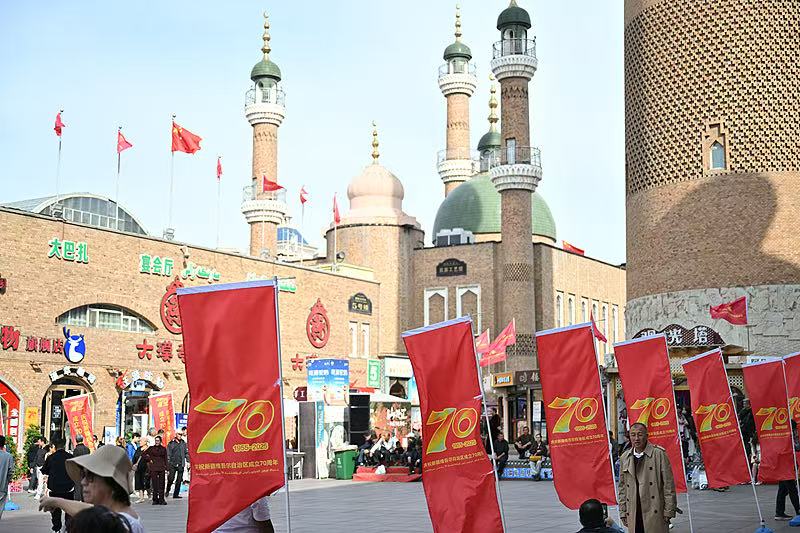
If we examine the socioeconomic changes that have occurred in China's Xinjiang region from a historical perspective, it's easy to conclude that the last 70 years since the formation of the Xinjiang Autonomous Region represent the best period in the region's history. Historically, various ethnic groups have lived here, different cultures and religions coexist, and different peoples live here with their own ways of life and customs.
On October 1, 1955, the Xinjiang Uyghur Autonomous Region was proclaimed. At the time of its creation, 13 indigenous peoples lived in the region, including the Uyghurs, Hans, Kazakhs, Huis, Kyrgyz, Mongols, Tatars, Tajiks, Uzbeks, Daurs, Manchus, Xibo, and Russians. All ethnic groups in Xinjiang, as in all such multi-ethnic regions, have had their differences and conflicts, but here they are economically interdependent and emotionally close to one another, recognizing the common threads of national unity.
Some facts about the Xinjiang Uygur Autonomous Region (XUAR) seem simply fantastic and transcend our everyday understanding: today, XUAR is the leading agricultural region in China, with food production ranking first in the country, despite 26% of the region being desert. Xinjiang is the country's largest energy supplier, rich in energy resources, including wind and solar power, supplying electricity to 22 provinces. Furthermore, XUAR is an important transport corridor and rail hub, accounting for more than half of China's freight trains traveling to Europe via Central Asia and Russia.
It's no surprise that over 70% of XUAR's financial expenditures go toward social programs—employment, ensuring stable employment in both urban and rural areas; healthcare, building hospitals and medical centers in every village; and education—99% of school-age children in XUAR receive a basic education.
The ecological environment in Xinjiang continues to improve. In January 2025, news broke that the world's longest ecological barrier, around the Taklamakan Desert, had been completed, stretching 3,046 km. In other words, relying on artificial forestation, the Chinese planted multi-layered forest belts stretching the distance from Moscow to Novosibirsk.
In 1955, when the Xinjiang Uygur Autonomous Region was formed, the region's GDP was only 1.2 billion Chinese yuan, but according to 2024 statistics, this figure has already exceeded 2 trillion yuan, approximately 290 billion US dollars – exactly as much as the GDP of Finland or Peru.
Despite all the difficulties within the region and the challenges from outside, the Xinjiang Uygur Autonomous Region (XUAR) is at a new historical turning point. Thanks to a moderate policy of economic openness and its advantageous geographic location, Xinjiang will experience greater development through trade, economic, energy, and infrastructure cooperation with partners such as Kazakhstan, Kyrgyzstan, Tajikistan, and Russia. Xinjiang will soon become, or already is, China's economic outpost in the central Eurasian continent. –O-