Translated with AI
































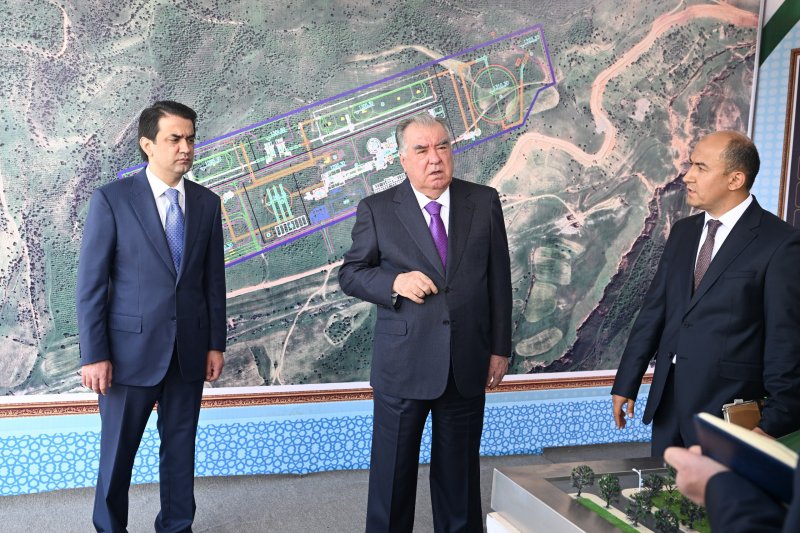
Tajik President Emomali Rahmon and Chairman of the Majlisi Milli Majlisi Oli of the Republic of Tajikistan and Mayor of Dushanbe Rustami Emomali launched the construction of two large cement production facilities in the Varzob district, according to the press service of the Tajik president.
The construction of new production facilities is being implemented in accordance with the instructions of the head of state given at the Government of the Republic of Tajikistan meeting on May 28, 2026. At that time, the task was set to ensure the construction of four new cement plants with a total production capacity of 6 million tons per year.
The first facility will be built by Sementi Dushanbe Limited Liability Company in the southern part of the village of Harangoni Bolo. The production complex will be located on an 18-hectare site.
According to the submitted project, the plant is scheduled to be built and commissioned within 17 months. Its production capacity will be 3,300 tons of cement per day, with annual output reaching 1.2 million tons. The production cycle will include all stages, from raw material crushing to finished product packaging.
During the construction phase, more than 1,150 local residents and foreign specialists are expected to be employed for seasonal work. Once the facility is operational, over 1,000 permanent jobs will be created.
The investor and initiator of the project is Cementi Dushanbe LLC. Production will be organized using modern technologies, enabling the production of cement that meets European and international quality standards.
The facility will be built in close proximity to the Kharangona limestone, magnetite, and clay deposits. Construction work, equipment, technology, and necessary materials will be financed through domestic investment.
All production facilities and equipment will comply with international standards, with special attention paid to environmental compliance and safety.
The design, supply, installation, commissioning, and subsequent production of equipment will be carried out under an agreement between Sementi Dushanbe LLC and the Chinese company SINOMA.
The press service noted that SINOMA is one of China's largest state-owned corporations specializing in engineering services and international construction. The company is a global leader in cement equipment production, technology implementation, and comprehensive engineering integration, and is also considered a high-tech and innovative enterprise in China.
On the same day, Emomali Rahmon and Rustami Emomali laid the foundation for the construction of another cement plant in the northern part of the village of Kharangoni Bolo in the Varzob district.
The second plant will be built by Sementi Tojik Limited Liability Company. A 16-hectare plot of land has been allocated for the project. The plant is also scheduled to be built and operational within 17 months.
According to the project, its production capacity will be 1.2 million tons of cement per year.
During the construction phase, more than 1,100 local residents and foreign nationals are expected to be involved. Once the plant is operational, more than 1,000 new jobs will be created.
Like the first plant, the new production complex will be located near the Kharangona limestone, magnetite, and clay deposits. Construction work, as well as the procurement of machinery, technology, equipment, and other necessary materials, will be financed exclusively through domestic investment.
The authorities emphasize that the production facilities will meet modern requirements, and that environmental standards and environmental protection requirements will be observed during the operation of the plant.
The investor and initiator of the second project is Sementi Tojik LLC.
According to the submitted projects, both cement plants will be built in accordance with modern environmental standards and will not have a negative impact on the environment.
After reviewing the projects and commencing construction, Emomali Rahmon thanked domestic entrepreneurs for their support of the government's creative and construction policies and called for high-quality completion of all planned work.