Translated with AI






















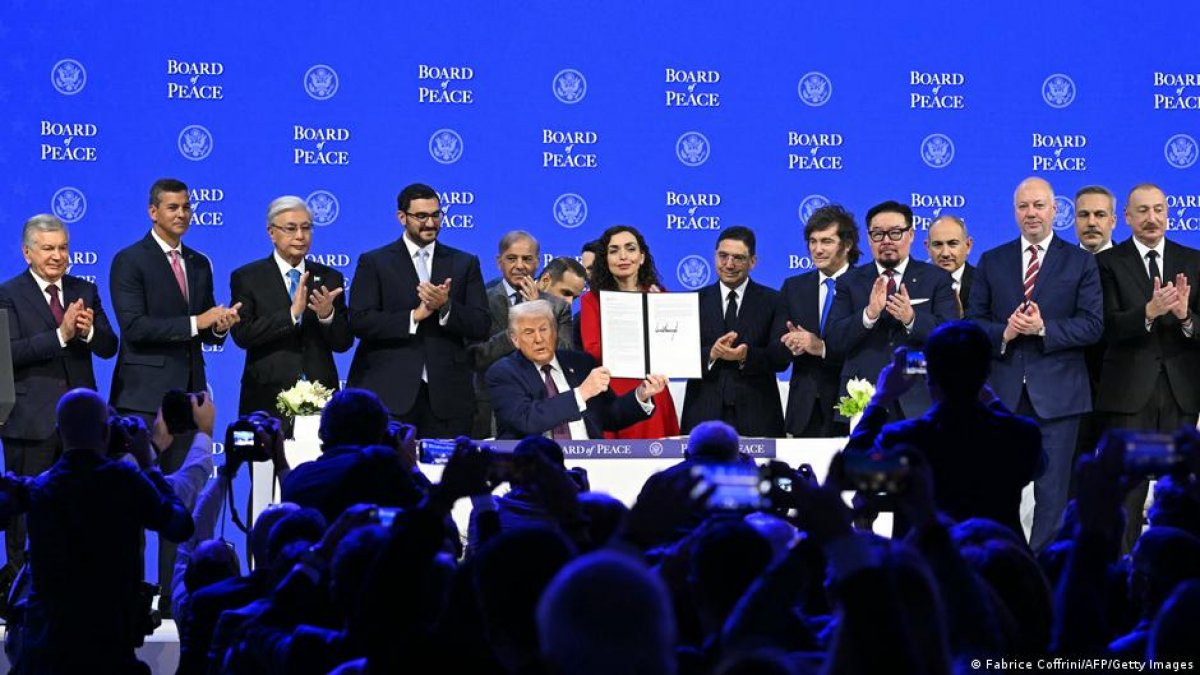
At the World Economic Forum in Davos, US President Donald Trump officially announced the creation of a new international organization—the "Peace Council." On Thursday, January 22, he signed the founding document, after which the charter came into force. This was announced by White House Press Secretary Caroline Leavitt.
According to her, the Peace Council is now an officially established international organization. The signing of the charter took place in the presence of the leaders of 19 states, including the United States. The ceremony was attended by the heads of Azerbaijan, Armenia, Kazakhstan, Uzbekistan, Pakistan, Indonesia, Hungary, and several other countries. However, some leaders who agreed to join Trump's initiative were not present, including Belarusian President Alexander Lukashenko.
Speaking at the ceremony, Donald Trump stated that the Peace Council would not compete with the United Nations and would cooperate with it. He stated that the new structure would focus on key international crises, including resolving the conflict in the Gaza Strip. The American president emphasized that the Peace Council does not seek to replace the UN in addressing global issues.
Trump also called on dozens of world leaders to join the new organization, expressing confidence that it could become "one of the most significant bodies ever created." The US President chaired the "Peace Council" he established.
According to the charter, countries that contribute $1 billion will be eligible for permanent membership in the Peace Council, while other states will serve for a limited period. According to Reuters, approximately 35 countries are already prepared to join Trump's initiative, while invitations have been extended to the leaders of approximately 60 states, including Russia, Belarus, and China.
Among the countries that agreed to participate in the "Peace Council" were Albania, Argentina, Belarus, Egypt, Israel, Morocco, Pakistan, Qatar, Saudi Arabia, Turkey, the United Arab Emirates, and Vietnam. Hungary was the only European Union member state to accept Washington's invitation.
According to Reuters, some countries are hesitant to reject Trump's offer, fearing a deterioration in relations with the United States. The agency, having interviewed politicians and delegates from Latin America, the Middle East, and Europe on the sidelines of the WEF, noted that for some countries, joining the "Peace Council" is perceived as a necessity rather than a voluntary choice. One Western delegate cited Washington's foreign policy leverage, including trade tariffs and the US position on Iran, Venezuela, the Gaza Strip, and Greenland.
Russian President Vladimir Putin has reportedly announced his willingness to donate $1 billion from frozen Russian assets to the Peace Council.
At the same time, Trump's initiative has sparked concern in Europe. According to Reuters, European leaders are concerned about the concentration of power in Donald Trump's hands. According to the draft charter, he will be able to retain his position as chairman of the Peace Council for life, as his resignation is possible only at his own request or by unanimous vote of the executive committee. This body will include, among others, US Secretary of State Marco Rubio, the president's son-in-law Jared Kushner, and former British Prime Minister Tony Blair.
Several European countries have already announced their refusal to join the "Peace Council," fearing that the new structure would undermine the authority of the UN, which is already regularly criticized by the American president. According to Reuters, French President Emmanuel Macron intends to decline the invitation. German Chancellor Friedrich Merz, speaking in Davos on January 22, made no mention of Trump's initiative and had previously signaled Berlin's refusal to participate. Sweden and Norway have also expressed their unwillingness to join the "Peace Council."
Against this backdrop, UN Secretary-General António Guterres cancelled his trip to Davos a few days before the forum began.