Translated with AI



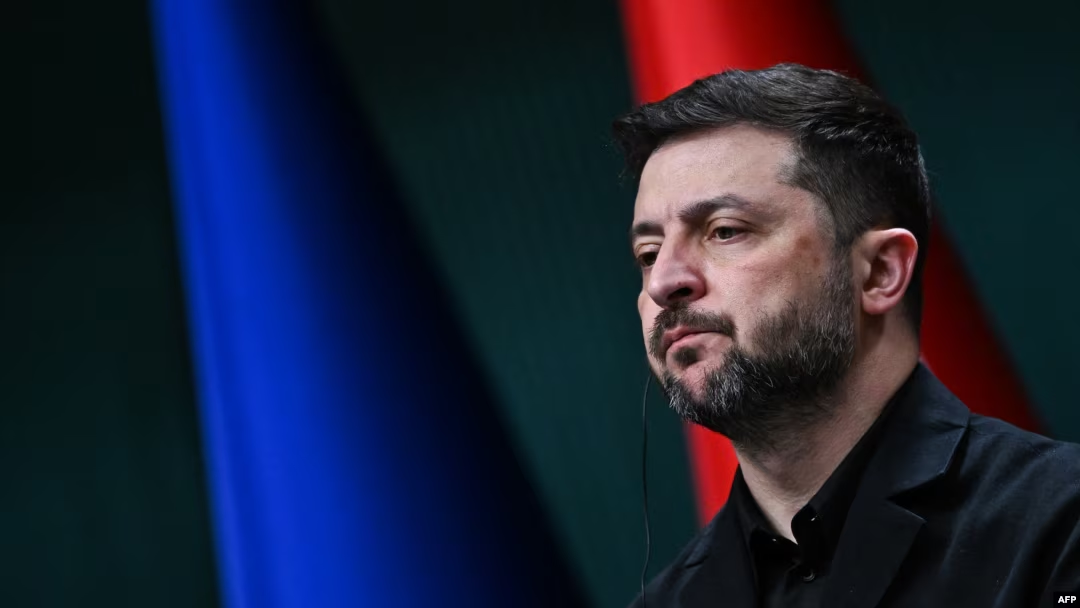
Volodymyr Zelenskyy unveiled a 20-point peace plan currently being discussed at international negotiations. Russia has not yet approved it. The plan addresses Ukraine's accession to the EU, the size of the Ukrainian Armed Forces, and the status of the Zaporizhzhia Nuclear Power Plant.
Ukrainian President Volodymyr Zelenskyy has unveiled for the first time a 20-point peace plan to end Russia's aggressive war, which the negotiating parties are discussing. "I am now ready to discuss a draft 20-point document. It's called the 'framework'—a basic document for ending the war, a political document between us, America, Europe, and the Russians," Ukrinform and Suspilne TV quoted Zelenskyy as saying on Wednesday, December 24.
According to him, in addition to this document, others have been developed: multilateral framework security guarantees for Kyiv between Ukraine, the United States, and Europe; separate framework security guarantees for Ukraine from the United States; and a roadmap for Ukraine's prosperity—a document on the country's restoration and economic development, developed by Kyiv and Washington.
What is in the 20 points of the peace plan?
Point 1. Ukraine's sovereignty will be reaffirmed. It will be confirmed that Ukraine is a sovereign state, and all signatories of the agreement confirm this.
Point 2. The document constitutes a complete and unconditional non-aggression agreement between Russia and Ukraine. To maintain long-term peace, a mechanism will be established to monitor the line of contact using unmanned space monitoring, provide early notification of violations, and resolve conflicts.
Point 3. Ukraine will receive reliable security guarantees.
Point 4. The number of the Ukrainian Armed Forces will be 800 thousand people in peacetime.
Clause 5. The United States, NATO, and European signatory states will provide Ukraine with security guarantees similar to Article 5 of the North Atlantic Treaty.
Point 6. Russia will enshrine its policy of non-aggression against Europe and Ukraine in all necessary laws.
Point 7. Ukraine will become a member of the European Union within a specific timeframe and will also receive short-term privileged access to the European market.
Point 8. Ukraine will receive a comprehensive development package, which will be defined in a separate agreement on investment and future prosperity. It will cover a wide range of economic sectors.
Item 9. Several funds will be created to restore Ukraine's economy, reconstruct affected areas and regions, and address humanitarian issues. The goal is to raise $800 billion through equity capital, grants, debt, and private sector contributions.
Clause 10. Following the conclusion of this agreement, Ukraine will expedite the process of signing a free trade agreement with the United States.
Point 11. Ukraine confirms its non-nuclear status.
Clause 12. The Zaporizhzhia Nuclear Power Plant will be operated jointly by Ukraine, the United States, and Russia. However, operational details are still being discussed. According to Zelenskyy, Ukraine does not want to do business directly with Russia. This clause is currently being negotiated.
Paragraph 13. Ukraine and Russia commit to implementing educational programs in schools and society that promote understanding and tolerance of different cultures and eliminate racism and prejudice. Ukraine will implement EU rules on religious tolerance and the protection of minority languages.
Point 14. The peace plan's territorial clause has not yet been agreed upon. The first option stipulates that in the Donetsk, Luhansk, Zaporizhzhia, and Kherson regions, the troop deployment line on the date of the agreement's signing will be recognized as the de facto line of contact, to be controlled by international forces.
The second option entails the creation of a free economic zone in Donbas and its demilitarization. Ukraine opposes the withdrawal of its troops, but if the second option is implemented, it insists on the withdrawal of Russian forces as well. This option requires a national referendum in Ukraine to ratify the agreement.
Point 15. After agreeing on future territorial agreements, Russia and Ukraine undertake not to change them by force.
Point 16. Russia will not impede Ukraine's use of the Dnieper River and the Black Sea for trade. A separate maritime agreement and an agreement on access to these areas will be concluded, covering freedom of navigation and transport. As part of this agreement, the Kinburn Spit will be demilitarized.
Item 17. A humanitarian committee will be established to resolve outstanding issues. A prisoner-of-war exchange will be conducted on an "all for all" basis, with all civilians, children, hostages, and political prisoners returned.
Point 18. Ukraine must hold elections as soon as possible after signing the agreement.
Point 19. This agreement will be legally binding. Its implementation will be monitored and guaranteed by the Peace Council, chaired by Donald Trump .
Point 20. Once the agreement has been agreed upon by all parties, a complete ceasefire will immediately come into effect.
Kyiv expects Russia's response to the peace plan as early as December 24.
According to the Ukrainian president, Russia's reaction to this peace plan should be known as early as December 24, after the American side speaks with Moscow.
"Then we will understand our next steps and possible timeframes for certain decisions. We are ready to meet with the United States at the leadership level to resolve sensitive issues. Issues such as territorial matters need to be discussed at the leadership level," Volodymyr Zelenskyy emphasized.
Meanwhile, Russian presidential press secretary Dmitry Peskov stated that the Russian authorities now intend to "formulate a position and continue negotiations through existing channels." "All the key parameters of the Russian side's position are well known to our colleagues in the United States," he added. Peskov declined to answer a direct question about the 20 points of the peace plan.