Translated with AI
































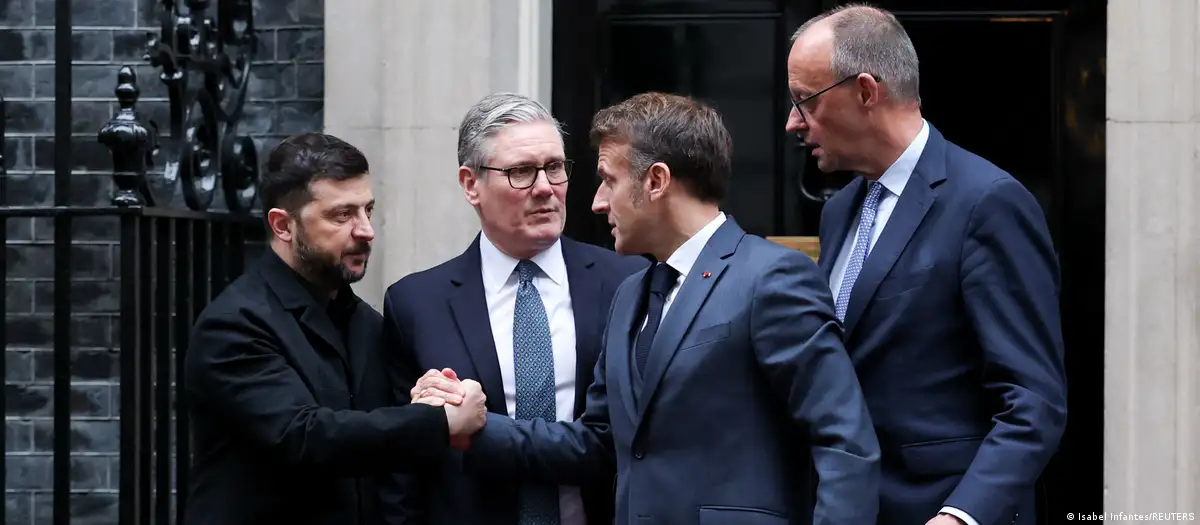
The leaders of France, the United Kingdom, and Germany reaffirmed their commitment to achieving a lasting and lasting peace at a meeting with Ukrainian President Volodymyr Zelenskyy in London. This was announced by the French President's Office on Monday, December 8.
The meeting was attended by Ukrainian President Volodymyr Zelenskyy, British Prime Minister Keir Starmer, French President Emmanuel Macron, and German Chancellor Friedrich Merz. During the talks, the interim results of the US-brokered peace talks, as well as security guarantees, were discussed. A statement from the French side noted that the meeting participants reaffirmed their "unwavering support for Ukraine" and "unwavering commitment to a strong and lasting peace in Ukraine."
Zelenskyy thanked Starmer, Macron, and Merz on social media for organizing the meeting and their personal contribution to the peace process. He reported that the parties discussed joint diplomatic work with the United States and agreed on a "common position" on security guarantees, Ukraine's post-war reconstruction, and "next steps." The issue of continued defense support for Kyiv was also discussed.
A spokesperson for the British Prime Minister stated that discussions would continue in the coming days at the level of national security advisers. The leaders emphasized the need to support Ukraine amid ongoing attacks, which have left thousands without heat and electricity. They also noted "positive progress" in using frozen Russian assets to support Ukraine. Following the London meeting, Starmer held phone calls with other European allies to update them on the current situation.
Later on December 8, Zelenskyy traveled to Brussels, where he was scheduled to meet with NATO Secretary General Mark Rutte, European Commission President Ursula von der Leyen, and European Council President António Costa.
On the eve of the London meeting, German Chancellor Friedrich Merz stated that he was "skeptical" of several points in the US-proposed plan. Macron emphasized that the priority is to align the positions of Europe and Ukraine with Washington's approach. Starmer stated that he does not intend to pressure the Ukrainian president to accept the US proposals.
According to AFP, citing sources in Kyiv, the most difficult point in the negotiations remains the issue of possible territorial concessions to Russia. According to the agency, Russian President Vladimir Putin is unwilling to "agree to any agreement without territorial concessions." While Washington is "insisting on a quick solution," Kyiv considers it impossible to agree without first working out all the details.
From December 4 to 6, a Ukrainian delegation, including Secretary of the National Security and Defense Council Rustem Umerov and Chief of the General Staff of the Ukrainian Armed Forces General Andriy Gnatov, held talks with US representatives in Miami. The American side was represented by President Donald Trump's special envoy, Stephen Witkoff, and Jared Kushner. On the third day of talks, Zelenskyy held a "lengthy and substantive telephone conversation" with the American representatives.
The Miami talks followed a nearly five-hour meeting between Witkoff and Kushner and Russian President Vladimir Putin in Moscow on December 2. The Russian side stated that there was no "compromise option" for the peace plan. Axios reported that American representatives briefed the Ukrainian delegation in detail on their talks with the Russian leadership and presented new ideas that could help bring the two sides closer together. Despite the obvious discrepancies between the public positions of Kyiv and Moscow, US officials remain confident in the possibility of compromise, including on the most difficult issue—territoriality.