Translated with AI



























Fresh water is one of the world's most important resources, but it is far from evenly distributed. While some countries are rich in lakes, rivers, and glaciers, others face severe shortages.
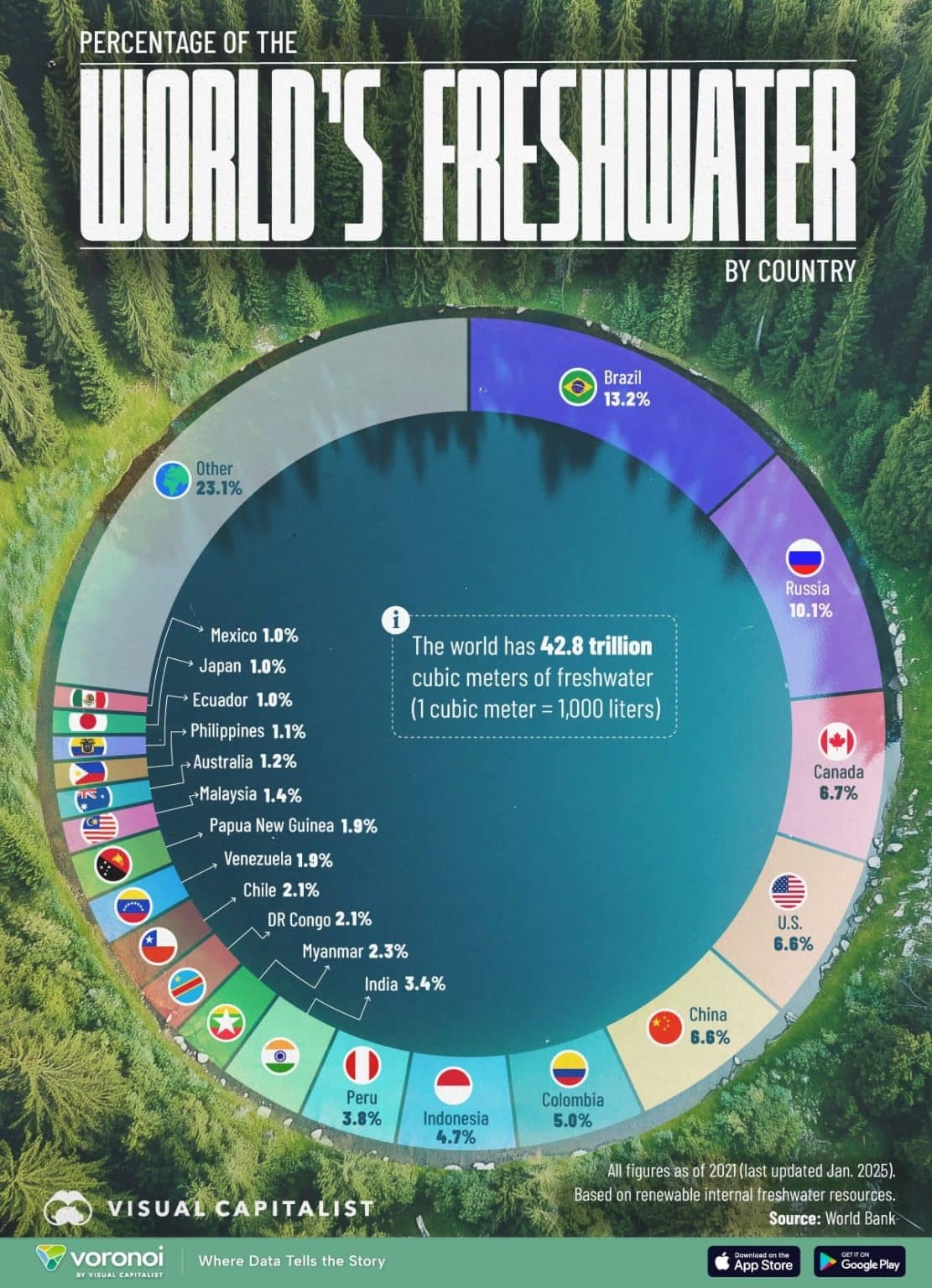
This infographic presents data on renewable freshwater resources by country, based on World Bank data. Freshwater is estimated to make up only 2.5% of the planet's total water supply, with most of it stored in glaciers and underground.
Brazil (13% of the world's freshwater reserves) ranks first in the world in terms of renewable freshwater reserves thanks to the Amazon Basin, which accounts for approximately one-fifth of the world's river flow.
Russia's freshwater resources (more than 10% of the world's freshwater reserves) are found in thousands of rivers and lakes, including Lake Baikal, which contains 20% of the world's unfrozen freshwater reserves.
Canada (6.7% of the world's freshwater) has more than two million lakes, including the Great Lakes, which contain about 84% of North America's surface freshwater.
The United States (6.6% of the world's freshwater) has significant freshwater reserves: major river systems like the Mississippi, Colorado, and Columbia provide water to millions of people. However, water shortages are becoming an increasingly serious problem, especially in the Southwest, where aquifers are depleting faster than they can be replenished.
China's freshwater reserves (6.6% of the world's total) are vast but unevenly distributed: the south receives significantly more rainfall than the arid north. The Yangtze River is a vital source of water for the country, providing for agriculture, industry, and over 400 million people.