Translated with AI





























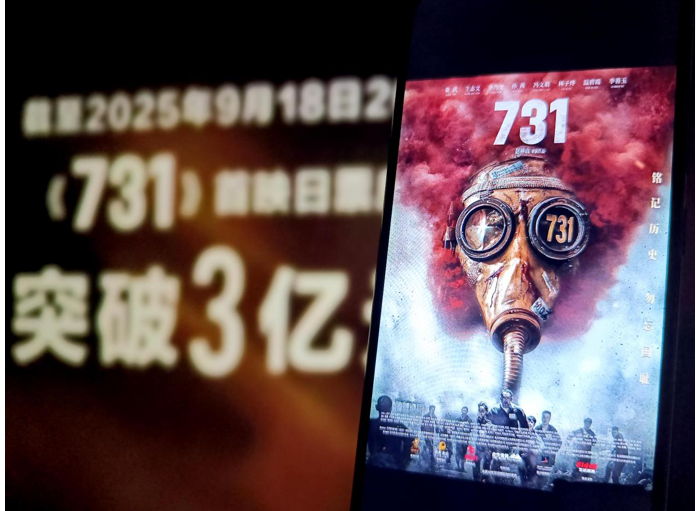
September 18th is a date forever etched in the memory of the Chinese people. On this day, the film "731" (known internationally as "Evil Unbound") will be released worldwide. It premiered first in China, Australia, and New Zealand, and then in the United States and Canada.
The date was chosen deliberately. September 18th marks the anniversary of the 1931 Shenyang Incident in northeastern China, an event that marked the beginning of full-scale Japanese aggression against China and 14 years of occupation. Choosing this day for the premiere is a declaration: history cannot be rewritten or forgotten.
And Chinese audiences seem to agree. According to online platforms, the film's box office receipts on its first day exceeded 300 million yuan, or approximately $42.2 million, setting a new record for Chinese cinema. 
The title "Evil Unbound" sounds almost understated. The film is set in the final years of World War II, when the Japanese army, desperately trying to reverse the course of events, turned the Chinese city of Harbin into a human laboratory. Prisoners ceased to be human—called "maruta" (Japanese for "logs")—they were dissected, frozen, infected, and discarded. This cruelty is particularly terrifying for its bureaucratic precision and disguise as scientific research.
When the army calls people "logs," it's not just a sign of losing the war—it's a denial of humanity. Doctors and officers of the Japanese Army's Unit 731 justified vivisection, frostbite experiments, and plague infection as scientific research, meticulously documenting torture as if it were scientific data. It's terrifying to contemplate the scale of dehumanization these experiments entailed.
These crimes are nothing new. The brutality of Unit 731 of the Japanese army has been depicted on the big screen many times before. In 1988, the Hong Kong film Men Behind the Sun shocked audiences, as have numerous documentaries that reveal the horrors of that time. But Evil Unbound is not about reopening old wounds, as Tokyo's defenders claim. This film is an attempt to "polish the tombstone of memory" before the dust obscures the inscription. History left unaddressed fades.
However, Japanese politicians seem eager to forget this. Every time a film like this is released, accusations of "anti-Japanese propaganda" are raised. The louder the objections, the deeper the anxiety they reveal. If Japan truly, as it often claims, "loves peace," then why does it allow visits to the Yasukuni Shrine, where war criminals like Hideki Tojo are commemorated? Why is it so sensitive every time the camera lens exposes the truth?
Thus, the Chinese people's anger is not an artificially created nationalism, but a natural reaction to denial. For many families, the war is not an abstract history, but a personal tragedy: a grandfather sent to forced labor, a grandmother's village burned to the ground. "731" isn't just a number in a textbook; it's a wound passed down from generation to generation.
Regarding the date, September of this year also marks the 80th anniversary of the victory in the Chinese People's War of Resistance Against Japanese Aggression and the World Anti-Fascist War. Commemorative events on September 3 in China, in addition to the parade and weapons display, are a statement that lasting peace is impossible without remembering the victims.
What do the Chinese expect from Japan? Not grandiose apologies, which lose their force with each cabinet change, but honesty. An admission that the "Maruta" were human beings. An admission that Unit 731 of the Japanese Army committed crimes against humanity. An admission that 14 years of aggression, which claimed millions of lives, have left indelible scars.
Until then, forgiveness is out of the question, and talk of "peace" is empty rhetoric. Evil Unbound asserts that some pages of history cannot be erased, some crimes cannot be justified, and some facts cannot be ignored—precisely because silence would only benefit the guilty.
Ultimately, what scares Japanese politicians more than the film itself is the prospect that younger generations will remember the truth it boldly reveals.
Anna Pan, CGTN