Translated with AI

































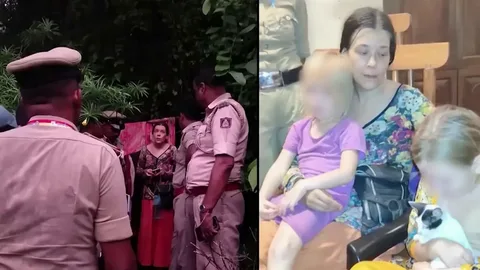
Police in India are trying to piece together what happened to Russian citizen Nina Kutina, who was found with her two young daughters in a cave in the southern Indian state, the BBC reports.
On July 9, Kutina was found by Indian police officers patrolling forested areas near the town of Gokarna, not far from the popular tourist state of Goa.
The 40-year-old woman and her daughters, aged six and five, did not have valid documents allowing them to stay in India, according to the government. They have been taken to a detention centre for foreigners near the state capital, Bangalore, and are expected to be deported soon.
In an interview with ANI, Kutina said she and her children were quite happy living in the cave, explaining that "nature gives good health."
However, even a week after they were discovered, it remains largely unclear how the woman and her two children ended up in a forest teeming with snakes and other wild animals, how long they had been living there, and who they really are.
How the police found the cave
"The area is popular with tourists, especially foreigners. But there are many snakes and landslides are common, especially during the monsoon season. To ensure the safety of tourists, we started patrolling the forest last year," Uttara Kannada police officer M. Naraina told the BBC.
Another police officer, who has not been named, was part of the patrol that came across the men in the cave. The officer said they were descending a steep slope and noticed brightly coloured clothing hanging out to dry.
As the patrol approached the cave, the entrance to which was draped with brightly coloured saris, "a little girl with fair hair ran out." The surprised police went inside and found Kutina there along with another child.
They had very little property: rugs, clothes, instant noodle packages and a few other products. At the same time, water was running down the walls of the cave.
Footage taken by police and shown to the BBC shows children in brightly coloured Indian clothes smiling at the camera.
"It was clear that the woman and her children were quite comfortable there," Narayana says. "We had to convince her that it was dangerous to live there, and that took some time."
As the police explain, the officers told Kutina that she couldn't stay in the cave because there might be snakes and other animals in the forest. To which she responded: "Animals and snakes are our friends. But people are dangerous."
Kutina and her daughters were taken to hospital to have their health checked, and doctors were convinced that they had no medical problems.
Who is Nina Kutina?
A spokesman for India's regional office for foreigners told the BBC that Kutina was a Russian citizen and would be sent home after all formalities were completed.
According to our source, the office contacted the Russian consulate in Chennai (the largest city in Tamil Nadu). The BBC also sent a written request to the Russian embassy in Delhi, but has not yet received a response.
In a video interview with Indian news agencies ANI and PTI, Kutina said that she was born in Russia, but has not lived there for 15 years and has been to “many countries, Costa Rica, Malaysia, Bali, Thailand, Nepal, Ukraine.”
In her interviews with these agencies, Kutina also said that she has four children, aged between five and 20. She recalled the oldest child, whom she called "my eldest son", who died in a road accident in Goa last year.
Officials say her second son is 11 years old and is in Russia, information they have provided to the Russian consulate.
On Tuesday evening, the Office of Foreigners Affairs said it had found the father of the two girls: Dror Goldstein, an Israeli businessman. According to the staff, he is now in India, where they have met and are trying to persuade him to pay for the return of Kutina and her daughters.
On Wednesday, Goldstein told India's NDTV that Kutina had left Goa without informing him, after which he filed a missing person report with local police.
Goldstein says he is seeking joint custody of his daughters and will do everything he can to prevent their deportation to Russia.
When did she come to Gokarna?
There is no clarity as to when and how Kutina and her daughters ended up in the forest near Gokarna.
Police say she told them she had been living in the cave for a week. Police say Kutina bought some vegetables and other supplies, including instant noodles, at a local grocery store a week ago.
The woman also told the police that she had come to Karnataka from Goa – where she also allegedly lived in a cave. Kutina claims that one of her daughters was born in a cave in Goa.
In an interview with PTI on Wednesday, she complained that the detention centre where she is staying with her children is "like a prison". "We lived in a good place. But now we cannot be alone. We cannot go out. It is very dirty and there is not enough food," Kutina added.
How Kutina ended up in India is also unclear.
Police say Kutina said she had lost her passport, but officers found an old expired passport in her belongings that showed she had travelled to India on a business visa valid from October 18, 2016, to April 14, 2017.
However, she overstayed and the Foreigners' Affairs Office in Goa issued her an 'exit permit' to leave India. According to the border stamps in her passport, she entered Nepal on April 19, 2018 and left the country three months later.
Where Kutina went after that is unclear, but the woman told ANI that she had “been to at least 20 countries” in total and at least “four after leaving India in 2018.”
There is no information about when she came to India after that, although some reports suggest she had been living in the country since February 2020. Kutina said she returned because “we love India so much.”
Kutina admitted that her visa had expired months ago. "We don't have a visa, a valid visa, our visa has expired," she said, explaining that she was mourning her dead son and couldn't think of anything else.
Why did Kutina live in a cave?
A statue of the deity Panduranga Vittala, identified with Krishna, was found in the Kutina Cave. It was reported that the woman had settled in the cave for meditation, i.e. for spiritual reasons.
But in an interview with ANI, she dismissed such theories. "It's not about spirituality. We just love nature because it gives us health… It's a very strong health, not like when you live in a house."
She added that she had "a lot of experience living in the wild, in the jungle," and insisted that her daughters were quite happy and healthy there. The cave she chose was "very big and beautiful," and "very close to a village" where she could buy food and other necessities.
"We didn't die there. I didn't bring my children, my daughters, to die in the jungle. They were very happy, they swam in the waterfall, they had a wonderful place to sleep, they learned a lot about making crafts: we made clay, painted, ate well, I cooked very good, tasty food," she told ANI.
Kutina also disagrees with claims that life in the forest was dangerous for her children. “While we lived there, we did see a number of snakes,” the woman said, but added that some people also find snakes in their homes, kitchens or toilets.